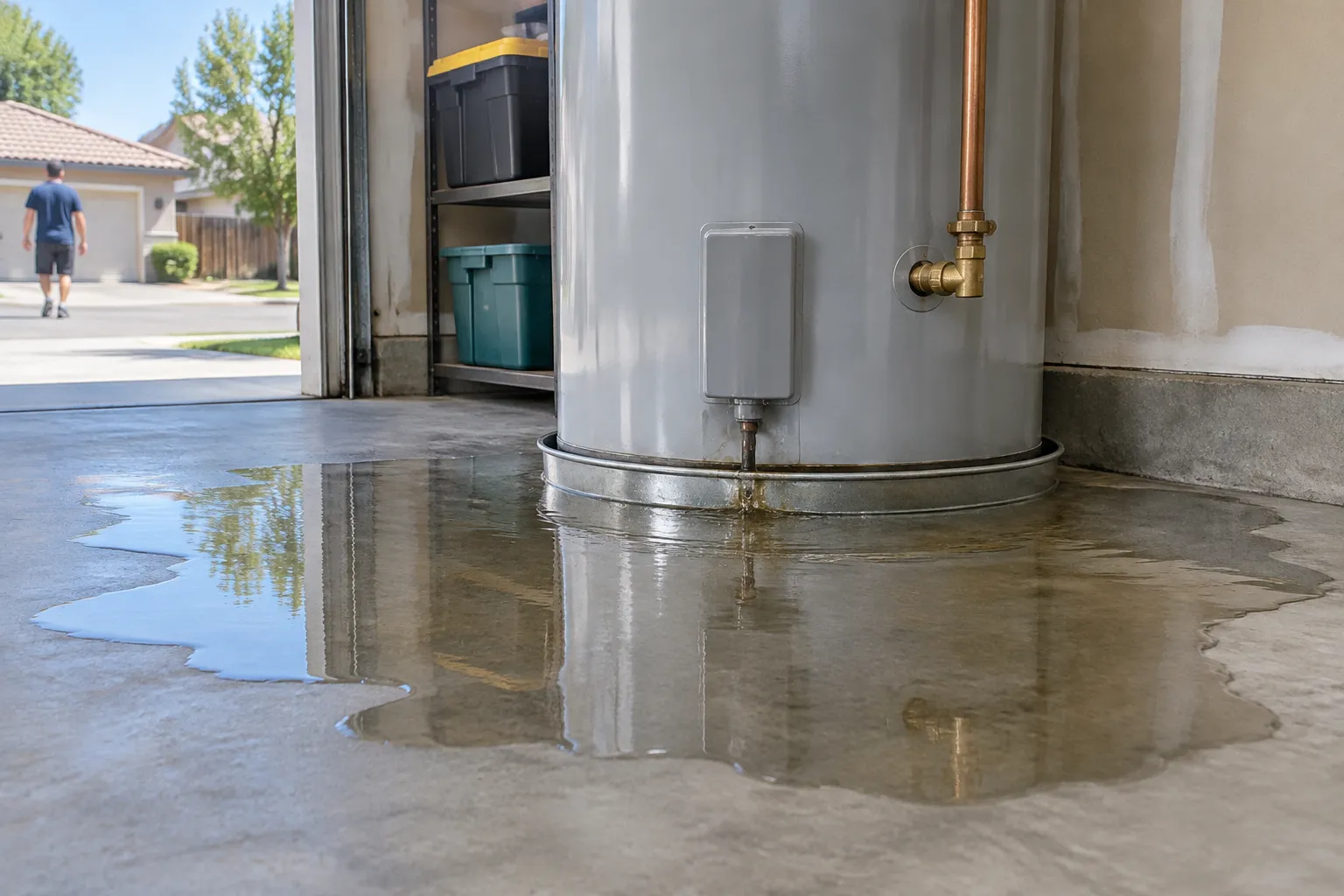
A leaking water heater needs two quick steps: switch off the power or the gas, and close the cold-water valve above the tank. Then find where the water comes from. A leak from a fitting, valve or pipe on top can often be repaired. Water coming from the bottom of the tank usually means the inside of the tank has corroded through, and a tank in that state cannot be repaired. If you want to understand how corrosion is slowed, our page on the anode rod in a water heater covers it.
What should I do first when my water heater is leaking?
Turn off the energy supply and the water. For an electric heater, switch off the breaker. For a gas heater, turn the gas control to off or pilot. Then close the cold-water shutoff valve on the pipe above the tank, and open a hot tap in the house so the pressure drops.
Do not open the drain valve while the water is hot. Put towels or a bucket down, and protect electronics and anything stored near the tank. If you smell gas at any point, leave the home and call 911, and then PG&E, as PG&E advises, and do not use switches or phones near the heater. Switching the heater off keeps the heating element from running dry, which can burn it out. Take photos of the leak and the tank label, because they help a plumber and an insurer.
Where is the water actually coming from?
Dry the heater and the area around it, then watch for where the first drop appears. Water at the top points to the pipe connections, the relief valve or the anode rod fitting. Water running down the side may have started higher. Water only at the bottom could be the drain valve, a fitting, or the tank.
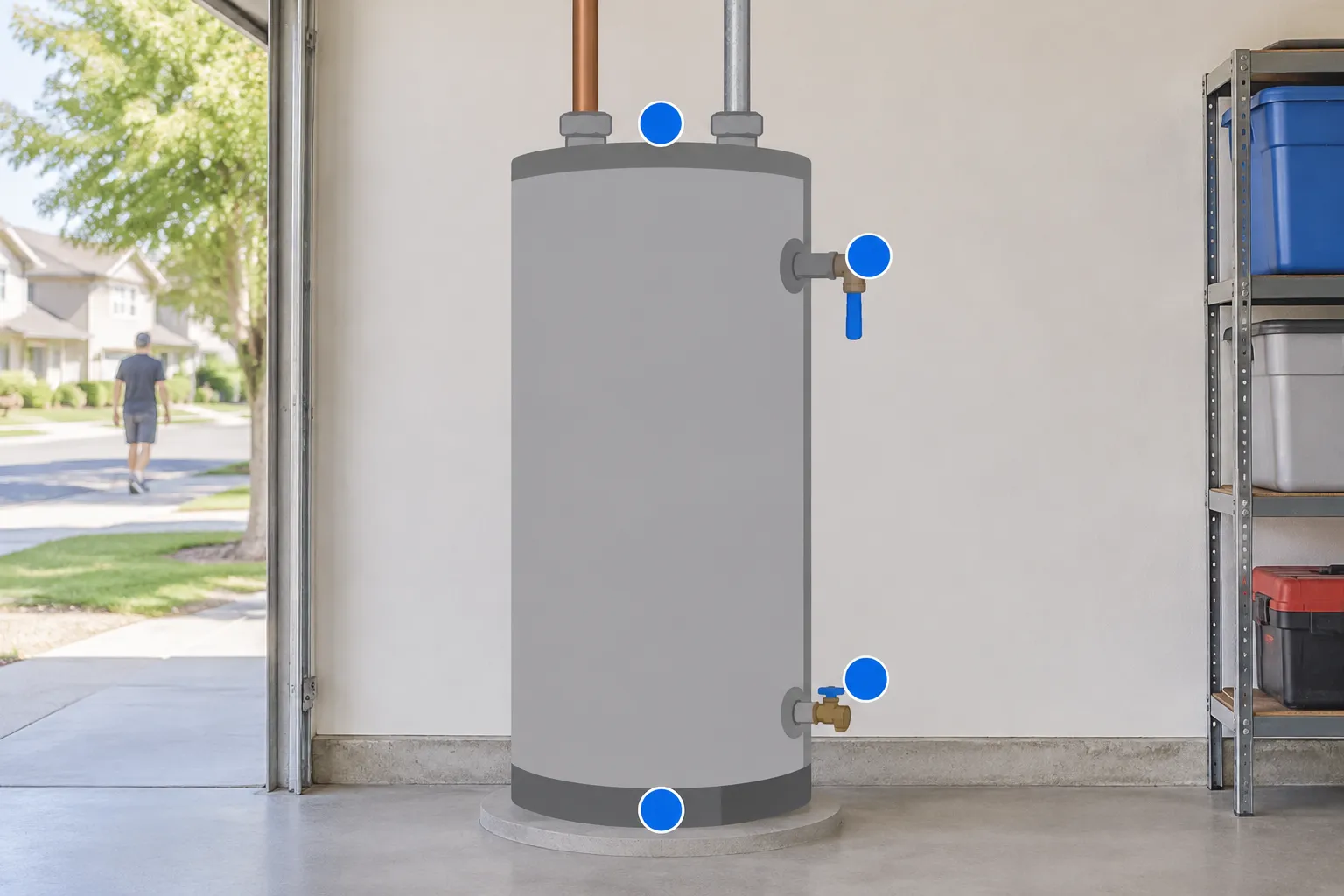
Check these spots one by one:
- Cold and hot pipe connections on top: tighten a loose one a small turn, and see if it stops. Corroded fittings may need replacing.
- The pressure relief valve and its discharge pipe: a drip here is a separate issue; see pressure valve leaking.
- The drain valve near the bottom: a slow drip from the spout may need a new valve or a cap.
- The electric heating element panels on the side: a wet insulation panel can mean a bad element gasket.
- Condensation: a gas heater can produce moisture on a cold tank or flue. Condensation tends to be light, appears on the outside, and fades when the tank heats up.
Why is my water heater leaking from the bottom?
The usual reason is internal corrosion. The steel tank sits inside an outer jacket, so when it rusts through, water pools underneath and runs out the bottom. Sediment collects at the base and speeds the damage, and an anode rod that has worn away can no longer protect the steel.
It is also possible that the leak is from the drain valve, a bottom heating element or a fitting, and those are repairable. A good test is to see whether the water seems to come from inside the insulation or the jacket. If so, it is almost certainly the tank, and the heater needs replacing. Tank life varies a lot with water quality, how well it is maintained, and the model, so age is only a guide. If the unit is old, a repair on a leaking tank does not make sense. See water heater cost for the price drivers of a replacement, and compare options in tank vs tankless water heater.
Why is my water heater leaking hot water, or not heating?
A leak and a heating problem often go together. When the tank drains or the heater is switched off for safety, the water goes cold. Separately, a heater that stops producing hot water has its own causes: a tripped breaker, a failed heating element, a bad thermostat or a pilot that has gone out.
A short list for no hot water, once the leak is dealt with or ruled out:
- Check the settings. The thermostat should be at the setting you chose. The US Department of Energy suggests 120 degrees F for most homes. A heater turned down or off by mistake will run cold.
- Check the power. On an electric heater, look at the breaker and the reset button on the upper thermostat.
- Check the pilot or igniter on a gas heater, and follow the manual to relight it only if there is no smell of gas.
- Consider the heating element. An electric tank typically has two. If one has failed, you get lukewarm water and short supply.
- Think about sediment. A tank full of sediment heats slowly and makes popping noises.
The difference between a tripped breaker and a failed element is the age of the problem: a breaker can often be reset once, and if it trips again, stop and ask a local plumbing business. Turning the thermostat higher will not fix a failed element and only raises the scald risk.
Can I repair a leaking water heater or does it need replacing?
Repair a fitting, valve or element gasket if the tank is sound. Replace the heater if the tank body is leaking. A plumber can tell which it is on a visit, and the visit can confirm the age and condition of the unit and whether the replacement can be done in one trip.
Replacement means a new tank, a new relief valve and discharge pipe, and often code updates such as seismic strapping or an expansion tank. Water heaters in California are plumbing and gas appliances, so installation work falls under the plumbing contractor classification (C-36), and a permit may apply. This site is a quote service. A local plumbing business that visits holds its own state license, and you can check it at cslb.ca.gov. For an urgent no-hot-water or leaking situation, the emergency water heater repair page explains what to ask for, and the plumber quotes the price.