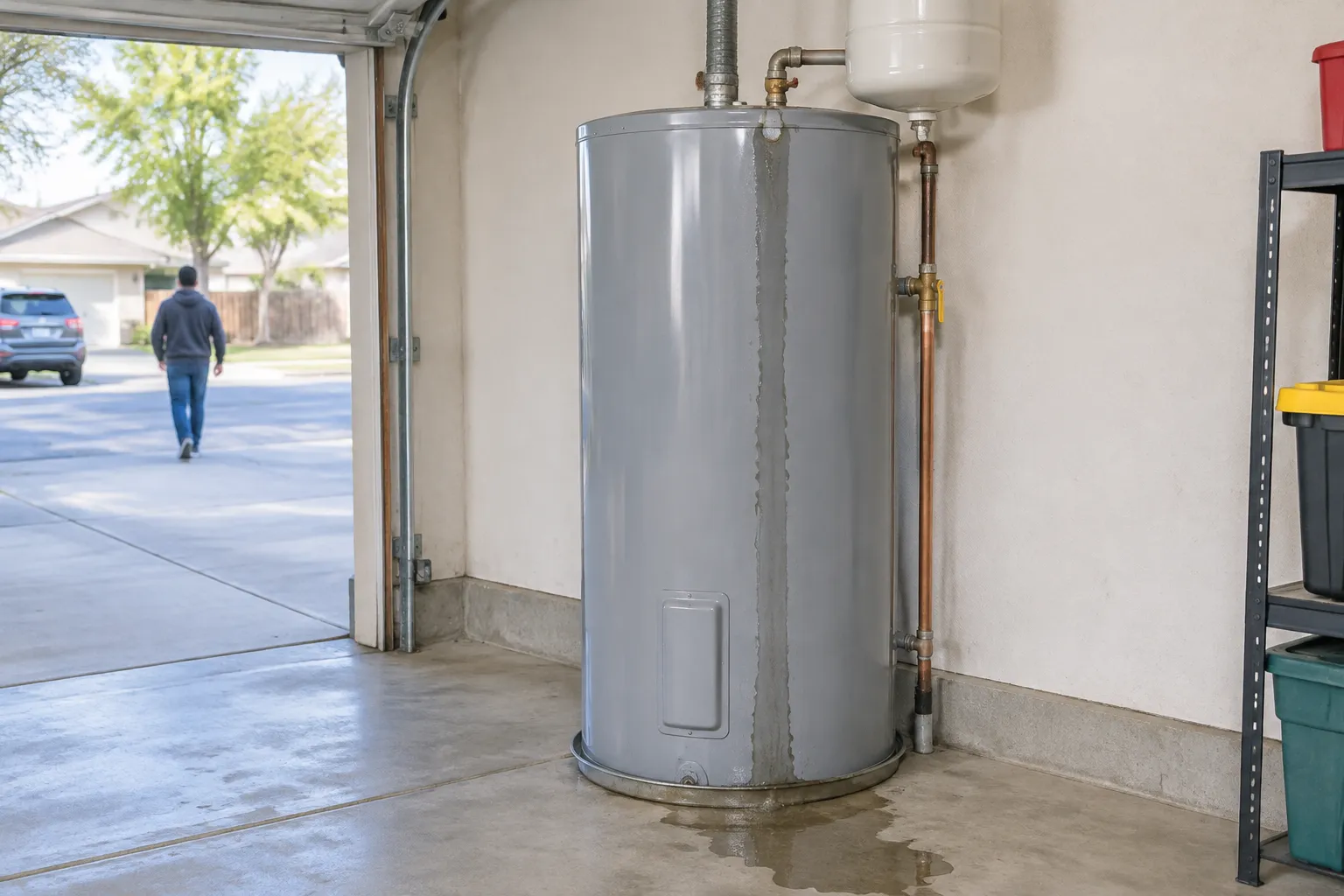
When a heater is leaking water, switch off its power or gas, shut the water supply to it, and find the source before you decide anything. The word heater covers a tank water heater, a tankless unit, a furnace with a humidifier, or a hot-water baseboard system, and each leaks for different reasons. Many of the leaks that show up near a heater come from the supply pipes around it. This page is part of the wider topic of leaks, burst pipes and repiping, and it starts with the safe first steps.
What should I do first if my heater is leaking water?
Turn off whatever energizes the heater, close its water supply, and keep people and pets away from wet floors near electrical outlets. For an electric unit, use the breaker. For a gas unit, turn the control to off. If you smell gas, leave the house and call 911, then PG&E, which is PG&E's own advice.
Then contain the water. Put down towels, a bucket or a wet vacuum, and if water is spraying from a pipe, close the main water valve for the house. Take photos before you clean up. If water is dripping from a light fixture or ceiling below, or from near the electrical panel, stay out of the area and switch off power at the main panel only if you can reach it without standing in water.
Is the leak from the heater or from a pipe near it?
Dry every pipe, valve and fitting around the heater with a towel, then wait 10 minutes and watch where beads first form. A pipe that sweats in humid weather, a loose fitting on the supply line, a failed shutoff valve, or a washer or sink nearby can all leave water at the heater's base.
Condensation is common on cold copper pipes, and it forms an even film, not a drip that keeps growing. A true leak keeps coming back after you wipe it. Follow pipes upward, since water runs along a pipe and drips at the lowest point. If you find the source is on the tank body itself, see water heater leaking. If it is a valve on top, pressure valve leaking explains that part.
How do I seal a leaking pipe for the short term?
You can slow a leak with a repair clamp, a rubber-and-clamp patch, epoxy putty rated for pipe, or a push-fit coupling, but these are temporary on anything under pressure that you cannot see all of. Shut off the water, dry the pipe, clean it, apply the patch following its label, and restore water slowly while watching.
Epoxy putty and wraps are made for pinhole leaks and small cracks. A compression clamp works on a split. Neither is a permanent repair for a pipe that is corroding all over, because a pinhole in an old copper pipe often means the wall has thinned along its length. The rule of thumb is that a patch buys time for a proper repair, and it should not be hidden behind a wall.
How do I repair a leaking copper pipe?
For a leak at a soldered joint or a split, the proper repair is cutting out the damaged section and joining a new piece with solder, a compression fitting or a push-fit coupling. Soldering needs a torch, flux, and a bone-dry pipe, so many homeowners choose push-fit couplings, which slide on with no heat.
Be careful with a torch near wood framing, insulation or a gas line. If the pipe cannot be drained fully, solder will not take. Pinholes in several places along a copper pipe, green staining, or flaking at the joints point to age or aggressive water, and the better fix may be replacing a run of pipe. A local plumbing business can assess that. Depending on your home, the fix can sit in a wall or under a slab, and a leak under a slab is a bigger job; see slab leak repair cost.
How do I repair a leaking plastic pipe?
The fix depends on the plastic. CPVC, PVC, PEX and polybutylene each use different fittings, and glues are not interchangeable. For PEX, cut out the bad section and join with crimp, clamp or push-fit fittings made for PEX. For PVC and CPVC, a coupling and the right solvent cement is the usual method.
Identify the pipe by its markings and color before buying parts. If you are not sure what you have, a local plumbing business can identify it, and the guide on SharkBite versus PEX fittings explains how fittings compare. A pipe that has burst from a freeze is different: it has usually split along a length, and the stretch around it may be damaged. Shut off the water at once and see burst pipe plumber.
How much does a leaky pipe cost to fix, and does insurance cover it?
Cost depends on whether the pipe is reachable, how much needs replacing, and whether a wall or floor must be opened. No published figure from a source worth trusting turned up, so the plumber quotes the real price after finding the leak. Insurance varies by policy.
Policies commonly treat sudden and accidental water damage differently from slow leaks caused by wear, and many exclude the pipe itself and cover only damage that follows. That is a general pattern, not a promise, so read your policy or ask your insurer, and document the damage with photos before you clean up. The US EPA notes the average household's leaks waste more than 9,300 gallons of water a year, which is why even a small leak is worth fixing early. If you are weighing who to call, the page on a plumber for a water leak explains what the visit involves.
When should a local plumber handle a leaking pipe?
Call a local plumbing business if the leak is in a wall, ceiling or slab, if you cannot shut off the water, if the pipe is gas or sewer instead of water, or if the repair needs a permit. Gas pipe work is always for a plumber, and in California, plumbing work of $1,000 or more must be done by a contractor with the right state license.
That threshold covers labor and materials, as the Contractors State License Board states, and larger or permitted jobs fall under the plumbing contractor classification, C-36. This site is a quote service, and the business that visits holds its own license, which you can check at cslb.ca.gov.