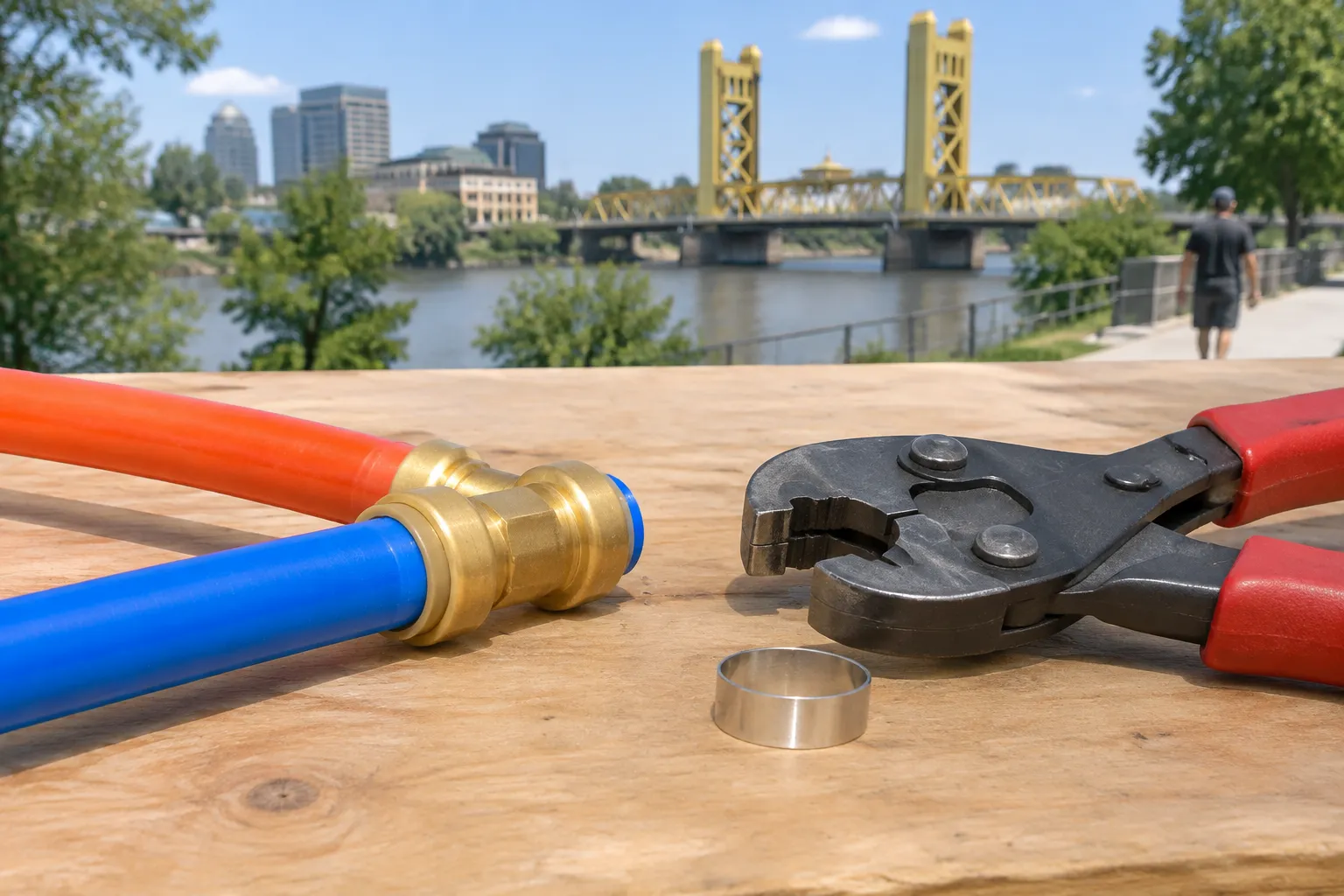
SharkBite is a brand of push-fit fitting. PEX-A and PEX-B are types of flexible tubing. They are not rivals: a SharkBite-style fitting pushes onto PEX of either type, as well as copper and CPVC, while the other systems join PEX using crimp rings, clamp rings or an expansion ring. Push-fit is quick and handy for repairs. For a whole-house repipe, plumbers often choose crimp or expansion joints. If you are fixing a leak, start with the leak and burst pipe plumbers page.
What is the difference between PEX-A, PEX-B and push-fit fittings?
PEX-A is the most flexible type and is joined with an expansion tool and ring, though it also accepts crimp, clamp and push-fit fittings. PEX-B is somewhat stiffer and is usually joined with crimp or clamp rings, and push-fit works on it too. A push-fit fitting is a fitting style, not a tubing type, so the same push-fit coupling can serve several pipes.
PEX-C is a third, less common type. Look at the printing on the tubing: it states the type, size and standards it meets. The fitting must match the pipe size and the standard it is listed for, and the manufacturer's instructions say what it accepts.
| Method | Works with | What it needs | Where it shines |
|---|---|---|---|
| Push-fit (SharkBite and similar) | PEX types, copper, CPVC, some others | No tool beyond a cutter and depth gauge | Repairs, tight spaces, transitions between materials |
| Crimp ring | PEX-A, B and C | Crimp tool and go/no-go gauge | Whole-house runs, widely available parts |
| Clamp ring | PEX-A, B and C | Cinch tool | Same as crimp, one tool for several sizes |
| Expansion ring | PEX-A only | Expansion tool | Full flow at joints, full-house repipes |
Push-fit fittings carry pressure and temperature ratings printed on the fitting or packaging, and approved uses vary by product, so read the packaging and the manufacturer's instructions.
Is push-fit or crimp better for a repair?
Push-fit is usually the better choice for a repair in a tight or wet spot, because the plumber can connect without a flame or special tool and can remove and reuse the fitting. Crimp or expansion joints are lower profile and cheaper for long runs. For permanent concealed joints, the plumber and the local inspector decide what is acceptable.
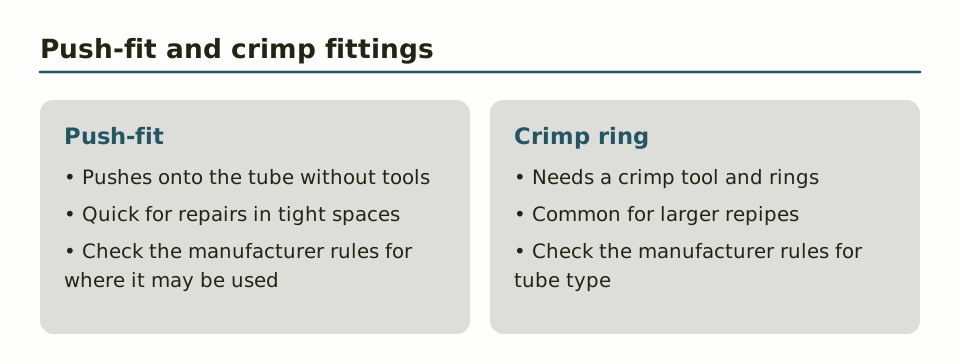
Rules on push-fit in concealed locations differ by manufacturer and by city, so it is a question for the plumber rather than an assumption. Pipes must also be cut square, deburred and pushed in fully. Many failures blamed on a fitting come from a bad cut, a scratch on the pipe or a fitting not fully seated.
Do not use PEX where sunlight reaches it for long periods, and keep it away from flue pipes and hot surfaces. Manufacturers set outdoor exposure limits and give clearance rules.
Is PEX allowed in California?
Yes. The California Plumbing Code allows PEX tubing for potable water in homes, with installation rules that follow the code and the manufacturer's directions. PEX-AL-PEX, which has an aluminum layer, is not adopted for potable water supply in the code. Local rules and the installation method still matter, so confirm with the plumber and the city.
PEX is allowed for potable water under the California Plumbing Code today, and it is a standard material. Plumbing contractors work in the C-36 classification, and you can verify a contractor at cslb.ca.gov.
How long does it take to repipe a house?
A repipe is usually measured in days, not hours, and the length depends on the size of the house, the number of fixtures, the pipe material, how many floors, wall and ceiling access and how much patching is included. A one-story house with open access goes faster than a two-story house with finished walls. The plumber should give a schedule in writing.
During a repipe the water is off for part of each day. The plumber may open small holes in drywall, run new lines through attics or crawlspaces and connect to fixtures, then patch or hand off patching. Ask if drywall repair and paint are part of the price, as they often are not.
A slab leak can be a reason to reroute lines through the attic or walls instead of fixing a pipe under concrete, which changes the scope. Ask each plumbing business how it would handle that.
Is it worth it to repipe a house?
A repipe is worth considering when pipes are failing repeatedly, are made of material with a poor record or are corroded inside. Galvanized steel, some early plastics and old copper with pinholes lead to repeated repairs. If you have had one leak in good pipe, a spot repair is usually enough. Count the leaks and the pipe type before deciding.
Signs to raise with a plumber:
- Pinhole leaks in several places in a short time
- Brown or rusty water from many taps
- Falling water pressure that a regulator does not fix (see water pressure regulator)
- A known problem pipe such as polybutylene
- Repeated repairs in the same walls
Repiping can lower leak risk and raise water flow, but it is a large job, so get several written quotes. See plumber cost for what moves plumbing prices, and the burst pipe plumber page if a pipe has already failed. When you are ready, request quotes and describe the house size, floors and pipe material.