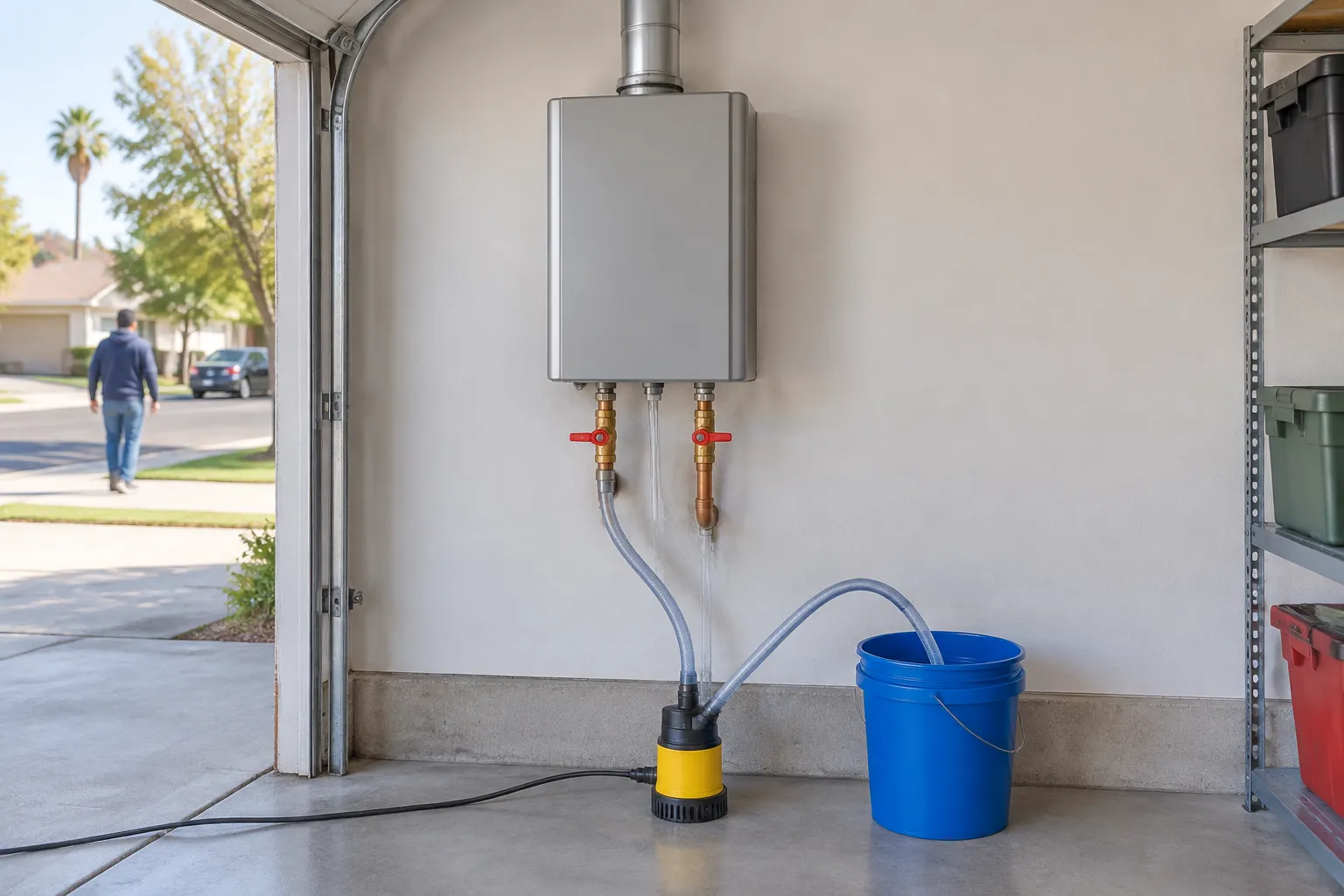
A tankless flush circulates a descaling liquid, usually white vinegar, through the heat exchanger to dissolve mineral buildup, then rinses it out with clean water. Rinnai, one of the main manufacturers, says to flush at least once a year, and more often in hard water. Check your own manual, because intervals and steps differ by model. If you do not have isolation valves, a plumber can add them. Start with the tankless installation overview if you are still choosing a unit.
How do you flush a tankless water heater?
You shut off power and gas to the unit, close the hot and cold water valves, connect hoses to the service or purge ports, circulate vinegar with a small pump for the time the manual gives, then drain it, flush with clean water, clean the inlet filter and return everything to normal. Follow the maker's steps for your model.
Rinnai's published procedure calls for about 4 gallons of undiluted white vinegar and says not to use chemical descalers. The steps below are the typical order; the manual for your unit has the exact version.
- Turn off the electrical supply or unplug the unit, and shut the gas valve.
- Close the cold and hot isolation valves.
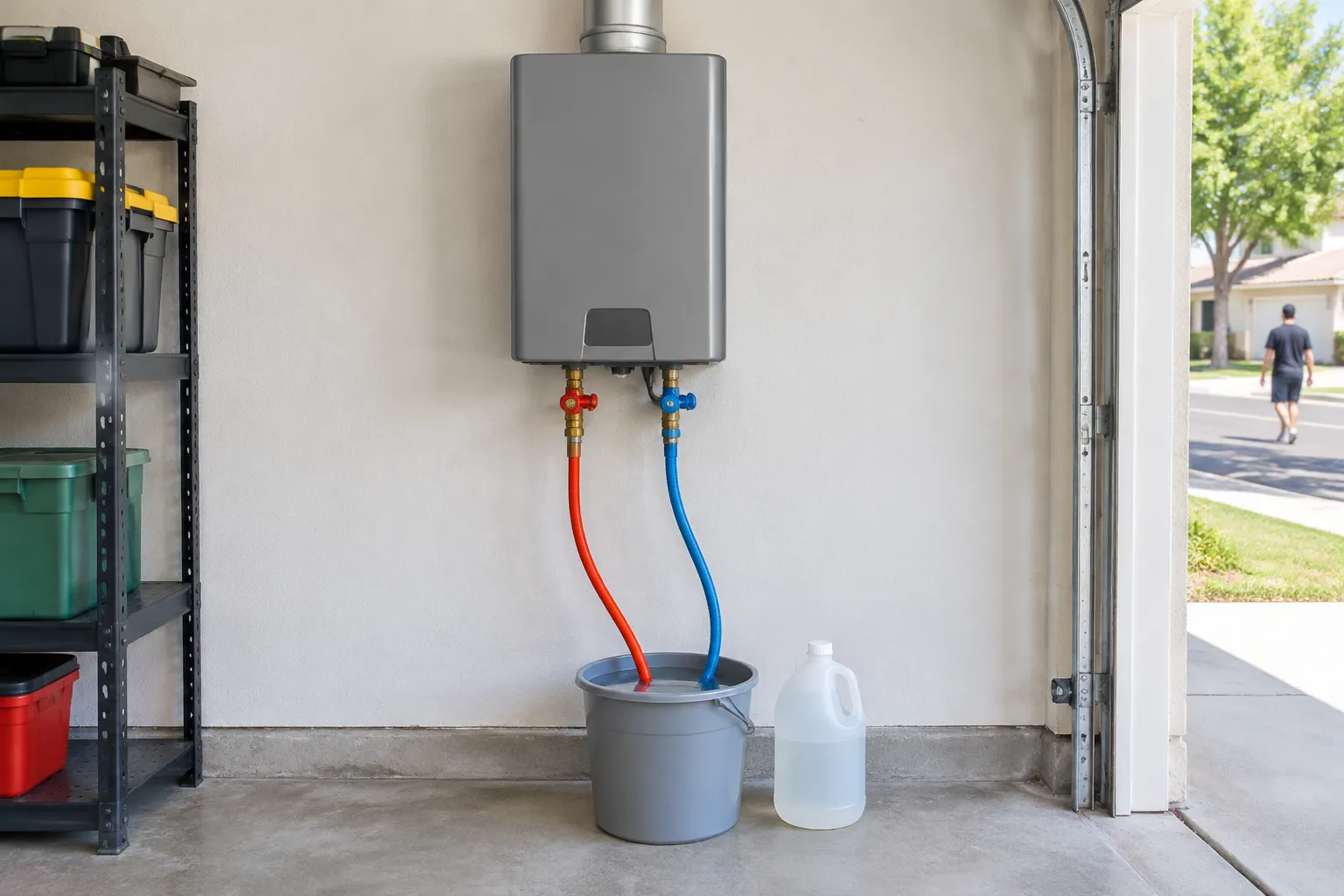
- Connect hoses to the purge ports and run them to a bucket and pump.
- Pour vinegar into the bucket, run the pump to circulate it through the unit, and keep it moving for the time the maker specifies.
- Drain the vinegar, flush with fresh water, remove and clean the inlet filter.
- Reopen the valves, check for leaks, restore gas and power, and run hot water to clear the lines.
If you smell gas at any point, leave the building, call 911 from outside and call your gas utility before anyone touches the unit again.
What do you need to flush a tankless water heater?
You need isolation valves with purge ports, two hoses, a small submersible or circulating pump, a bucket large enough for the vinegar, white vinegar and a way to catch the drain water. Without isolation valves, you cannot flush properly and risk water spilling through the unit, so install them first.
A submersible pump sits in the bucket and pushes vinegar through one hose; the second hose returns it to the bucket. Choose a pump rated for the flow the maker recommends. A tankless water heater flush kit sold by hardware stores generally bundles hoses and a pump. Do not use anything that is not rated for hot water and mild acid.
Do not use harsh chemicals. They can damage seals and the heat exchanger and are not what the manufacturer lists. A "flush solution" labeled for tankless units is fine if your manual accepts it; otherwise, stay with vinegar.
How often should a tankless water heater be flushed?
Once a year is the usual starting point, and Rinnai says at least annually. Hard water speeds scale, so some households do it more often. Your water supplier publishes an annual water quality report that lists hardness, and signs such as noisy operation, falling flow or error codes can mean the unit needs flushing sooner.
Scale thickens the heat exchanger wall, so the unit works harder and wears. Many installs also have an inlet filter that catches grit; clean it at the same time. Keep a record of the date. Some warranties ask for proof of maintenance, so check the paperwork.
If you also use a tank heater elsewhere in the house, the steps are different. See flushing a water heater and water heater flush for sediment.
Can you flush it yourself or should a plumber?
You can do a basic flush yourself if the unit has isolation valves, you are comfortable shutting off gas, power and water, and you follow the manual. Call a plumber if there are no valves, if the unit is gas and you are unsure about shutting it off, or if error codes remain after flushing.
Gas piping, venting and burner work need a California contractor license, so a flush that leads to a repair should go to a plumbing contractor. California's C-36 classification covers installing and replacing water-heating equipment and its safety devices. A flush with valves in place is a short visit for a plumber, and some businesses offer yearly maintenance plans.
What if you are installing an electric tankless unit?
Installing an electric tankless water heater is a larger job than a flush. It needs a dedicated, high-capacity circuit, correct wire and breaker sizing, shutoff valves for later flushing and a plumber or electrician who can pull a permit. Do not guess at the wiring. Talk to local plumbing businesses before buying the unit.
Isolation valves matter at the install stage because they make the first flush easy. For a comparison with tank models, see tank versus tankless water heaters. If the unit already has trouble, the instant water heater repair page covers common faults. Cost depends on the unit, the electrical work and access, and the tankless water heater cost page covers the drivers. When you are ready, request quotes.