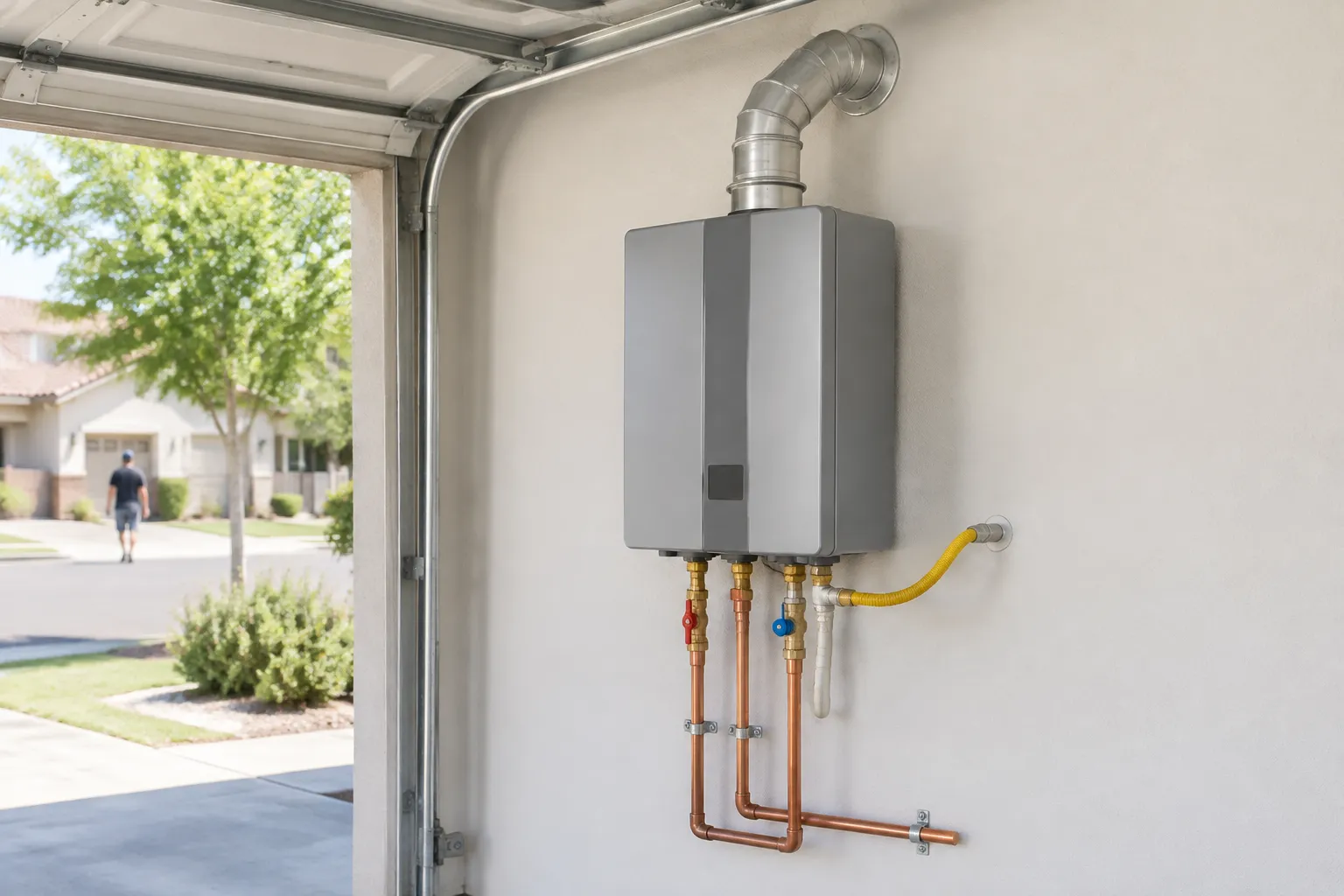
Tankless water heater installation replaces a storage tank with a wall-mounted unit that heats water only when a tap is open. In published national figures, a tankless installation runs from about $1,200 to $3,500, usually more than a like-for-like tank swap, because the job often adds venting, a bigger gas line or new electrical capacity. It can pay off in space saved and a longer service life, but not every home suits it. If you are still deciding, read tank vs tankless water heaters first, or go straight to the quote page. The Stockton plumbing home page lists the rest of the work.
Is a tankless water heater hard to install?
For a plumber, it is a larger job than a tank swap. The unit mounts on a wall, connects to cold and hot water lines, and needs a gas line and vent (gas models) or heavy electrical circuits (electric models). Because most homes were built around a tank, the plumber often has to modify piping, venting or the panel, which is where most of the extra cost sits.
The usual steps:
- Size the unit to your fixtures and the incoming water temperature.
- Choose a location, indoors or outside, that allows venting and clearances.
- Run or upsize the gas line, or add electrical circuits, with permits.
- Remove the old tank and cap or reuse its connections.
- Mount the unit, connect water, gas or power, and vent.
- Fit isolation valves for later flushing, set the temperature, test and walk you through it.
How much does it cost to install a tankless water heater?
A guide, not a quote: published national cost guides give about $1,200 to $3,500 for a tankless installation, against $900 to $3,000 for a tank. The plumber quotes the real price after seeing your gas line, venting path and electrical panel. The unit is only part of it. Labor, venting, new utility lines and permits make up the rest.
| Item | Typical range |
|---|---|
| Tankless unit installed | $1,200 to $3,500 |
| Tank unit installed, for comparison | $900 to $3,000 |
| Gas line added where none suits | up to $1,000 more |
| Removing the old unit | $100 to $500 |
What moves the price: gas or electric, the unit's capacity, how far the new location is from the old, whether the venting must go through a roof or wall, and permit fees. For more figures, see tankless water heater cost.
What are the benefits and downsides of a tankless water heater?
Benefits: it does not keep a tank of hot water warm all day, it takes less wall or floor space, and manufacturers expect it to last longer. Rheem puts typical tankless life at 15 to 20 years or more with proper care, against 8 to 12 years for a tank. Downsides: higher upfront cost, a retrofit that may need new gas, venting or wiring, and regular descaling in hard water.
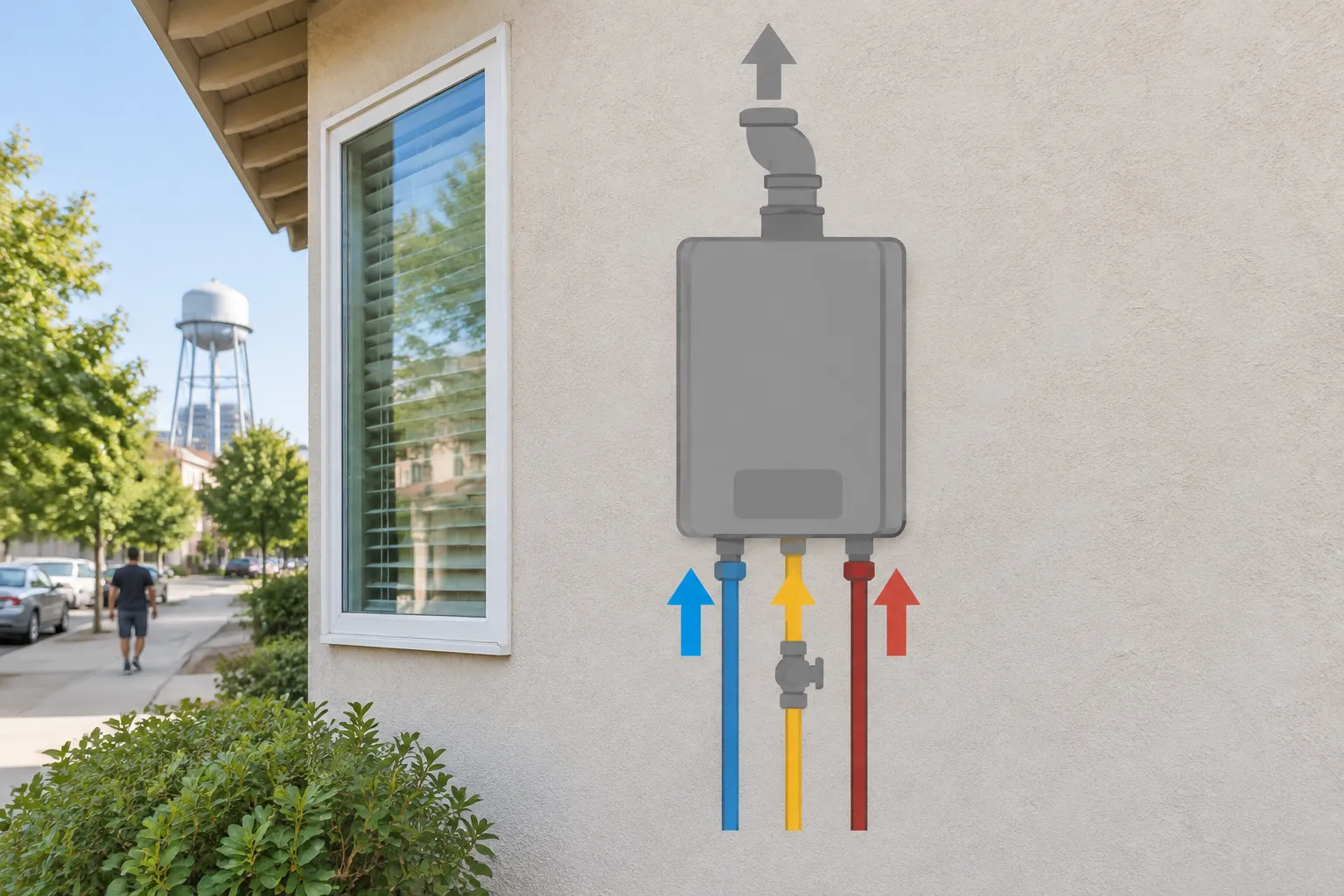
Energy savings depend on how much hot water your household uses, so ask the plumber to compare your expected usage and the added installation cost, not only the unit price.
Can you run two showers with a tankless water heater?
Often yes, if the unit is sized for it. Every tankless model has a maximum flow rate, in gallons per minute, that falls as the incoming water gets colder. Two showers plus a running dishwasher can exceed a small unit's limit and the water turns lukewarm. The plumber adds up your fixtures' flow and picks a model, or two units, to cover your busiest moment.
Tell the plumber how many bathrooms you have and how many people use hot water at once. This matters more than brand when choosing the unit, and it is also the main reason homeowners are happy or not with a tankless system.
What do you need to know about gas tankless installation?
A gas tankless heater typically burns more gas at once than a tank heater, so the existing gas line may need to be larger, and the unit needs a proper vent to carry exhaust outside. Gas and vent work must meet code and is done under permit. The U.S. Consumer Product Safety Commission advises a yearly professional check of fuel-burning appliances and their vents, plus carbon monoxide alarms on every level of your home.
In Stockton the gas utility is PG&E. If you smell gas at any time, leave the house, then call 911 and your gas utility from outside. Do not try to relight or fix a gas unit yourself. California requires a plumber who holds a California contractor license (CSLB classification C-36) for gas piping and permitted installs.
Does a tankless water heater need maintenance, and what about repair?
Yes. Minerals in the water build up on the heat exchanger and slow the unit down, and Rheem says tankless units should be flushed or descaled each year, mostly in hard-water areas. Hardness depends on your water supplier, so check the annual water quality report from your provider, such as the Cal Water report for the Stockton district if that supplies you. See the tankless water heater flush page for the process.
If a tankless unit stops working, the fault is often an error code, a scale problem, a failed sensor or a gas or power supply issue. A plumber reads the code and the manufacturer's manual. For more, see instant water heater repair.
Is there a tax credit for a tankless water heater?
Check before you count on it. Reporting indicates the federal energy efficient home improvement credit ended for equipment installed after December 31, 2025. Utility or state rebates, if any, change often. Ask the plumber and your tax adviser about what applies to your install date, and get the paperwork in writing.