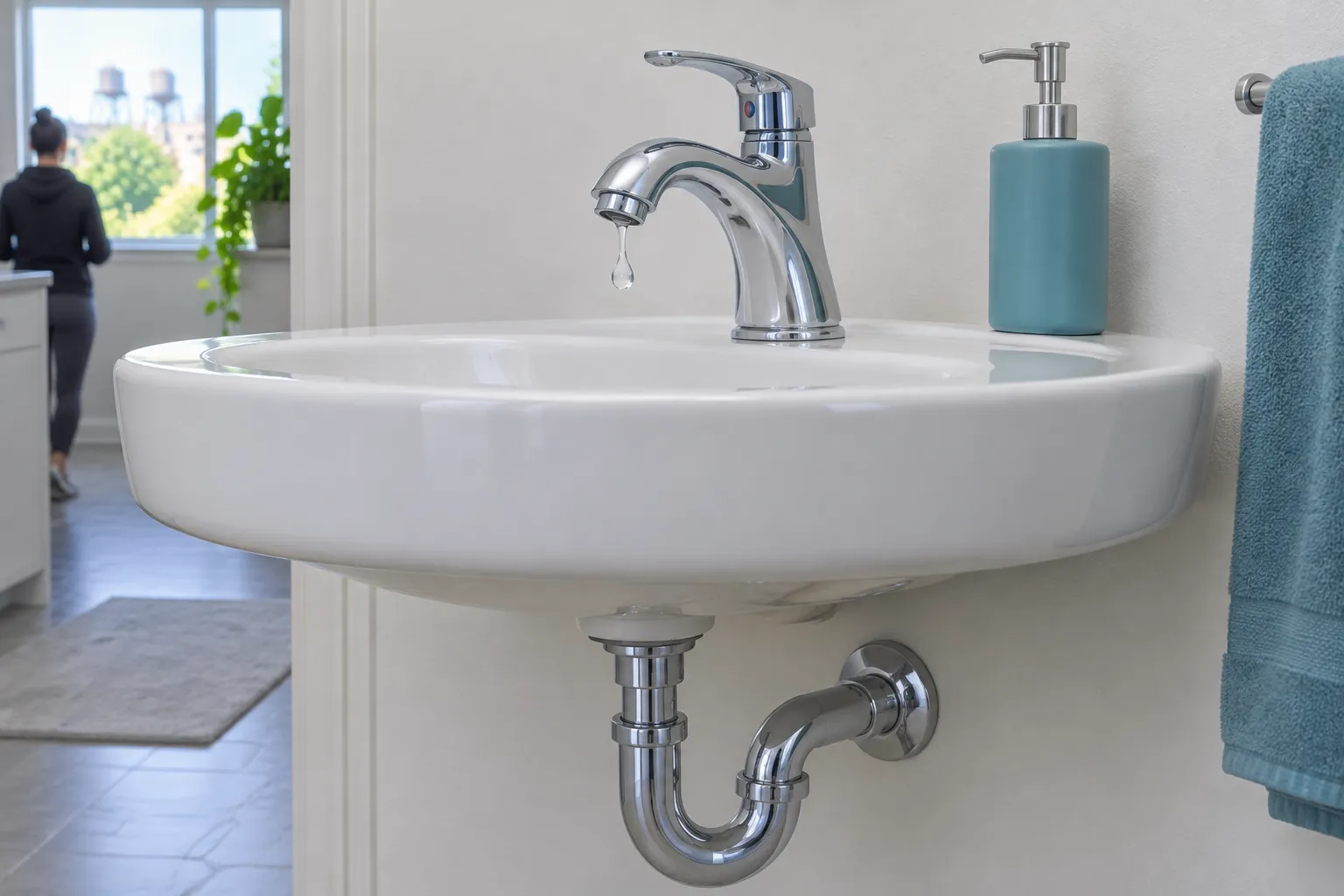
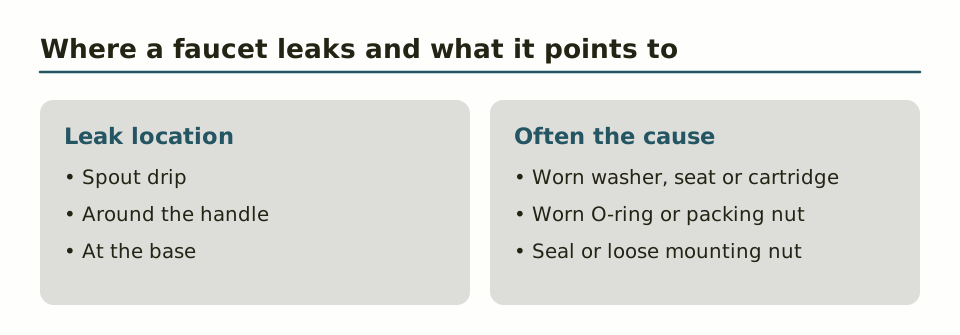
To repair a leaky faucet, turn off the water under the sink, plug the drain so small parts cannot fall in, take the faucet apart, and replace the worn part. In most faucets that is a rubber washer, an O-ring, a cartridge or a seat. A drip at the spout means a worn seal inside. A leak at the base or handle is usually an O-ring. This page helps you identify your type, walks through the repair, and covers the pipes under the sink. For the wider range of faucet, sink and shower work, see faucets, sinks and showers.
Before you start: what do you need and what type is your faucet?
You need an adjustable wrench, a screwdriver set, an Allen key set, pliers, a towel, a small container for parts, and replacement parts that match your faucet. Identify the type first: compression with two handles, or cartridge, ball or ceramic disc, which are usually single handle or two handle designs.
A quick guide:
- Compression faucets have separate hot and cold handles that you turn several times to close. They are the older style and leak at the spout when the rubber washer wears out.
- Cartridge faucets work with a stem inside a cartridge. They leak at the spout or the base when the cartridge or its O-rings wear.
- Ball faucets are single-handle with a rounded cap under the handle. They have several small seals and springs.
- Ceramic disc faucets are single-handle with a wide cylinder, and they leak when the seals or the disc cartridge wear.
Take the old part to the hardware store, or photograph the faucet brand and model name. Many makers publish a parts diagram. Water bills also climb with leaks: the US EPA's WaterSense program says a faucet dripping once per second can waste more than 3,000 gallons a year, and that fixing easy leaks can save about 10 percent on a water bill.
How do you repair a leaking faucet, step by step?
Shut off both supply valves under the sink, open the faucet to drain the lines, plug the drain, remove the handle, remove the cartridge or stem, replace the worn washers, O-rings or the cartridge, and reassemble in reverse order. Turn the water on slowly and check for drips.
- Close the supply valves under the sink by turning them clockwise. If they do not close, turn off the main water to the house.
- Open the faucet to let the water out, and plug the drain with a rag.
- Remove the handle. Pry off the decorative cap, remove the screw, and lift the handle. A set screw with an Allen key holds some handles.
- Remove the stem or cartridge. Unscrew the retaining nut with a wrench. Pull out the cartridge, and notice its orientation before it comes out.
- Inspect the parts. Look for worn rubber washers, cracked O-rings, a pitted seat, or mineral buildup. Compare with the new part.
- Replace what is worn. For a compression faucet, replace the washer and the screw, and check the valve seat. For a cartridge faucet, fit a matching new cartridge. For other types, a repair kit has the seals and springs.
- Reassemble and test. Turn the supply valves on slowly, and run the faucet. Check at the spout, handle and base.
If a seat is pitted or the faucet is old and corroded, a replacement faucet may be a better value than parts. If you replace the whole faucet, plumbing cost per fixture explains what affects the price of a fixture job.
Shower and tub faucets follow the same logic with different access, and repair leaking faucet covers the cases that differ.
How do you repair a leaking pipe under a kitchen sink?
First find the exact wet spot: run the water, dry the pipes, and wrap dry paper around each joint. Then tighten a loose slip nut by hand, replace a cracked washer, or replace a worn supply line. A pipe that is cracked or corroded through needs replacing, not tape.
Under the sink there are three groups of pipes:
- Supply lines are the flexible lines that feed hot and cold water to the faucet, connected to the shut-off valves. A leak at either end often means a loose nut or a worn washer, and a braided line that is kinked, rusty or bulging should be replaced.
- The drain and P-trap are the curved pipe below the sink. Leaks at the slip nuts happen when the nuts loosen or the washers wear. Tighten by hand and a quarter turn with pliers. If the pipe is old, brittle or cracked, replace the section.
- The garbage disposal connection, if you have one, has its own gasket and flange. A leak here may need the disposal looked at. See plumber for garbage disposal repair.
Put a bucket under the trap before loosening anything. Check that the washers sit flat inside the slip nuts. After you tighten, run water for a few minutes and check the dry paper again. If a leak appears only when the drain is in use, the problem is in the drain line. If it appears when the faucet runs, the problem is the supply side or the faucet base.
A pipe that has burst, spraying water or flooding the cabinet, is a different case. Close the shut-off valves, or the main, and read pipe burst under sink.
What if the faucet still drips after the repair?
If it still drips, the seat may be damaged, the part may not match, or the cartridge may be seated wrong. Take it apart again and compare. A new washer on a pitted seat will leak again. Mineral deposits in hard water can also stop a valve from sealing, and soaking parts can help.
Check the water pressure too. High pressure puts stress on seals, and a faucet that drips can be a sign of that. Banging pipes and fast-wearing parts are signs worth noting, and water pressure regulator explains what the device does.
Do not keep replacing parts if the faucet body is corroded or cracked. At that point a new faucet costs less than repeated repairs. And if the supply valves under the sink will not hold, those need replacing before you can do the faucet.
When should you call a plumber business?
Call when the shut-off valves do not close, the pipe is corroded or cracked, the leak is inside a wall or under the floor, the faucet body is damaged, or your repair has not worked after a second try. Also call if you are not comfortable with water lines.
Signs the leak is not just the faucet: a damp cabinet floor that stays wet, a musty smell, swelling in the wood, or a water meter that moves when all taps are off. Water inside a wall or below a floor can damage materials before you see it.
Most small faucet repairs cost little in parts, and the plumber quotes the price for labor and any parts. California generally requires a contractor license for work that needs a permit, uses additional workers, or costs $1,000 or more in labor and materials, according to the Contractors State License Board. A simple faucet repair is usually below that line. For larger jobs, ask the business that visits whether it holds its own license, and check at cslb.ca.gov.