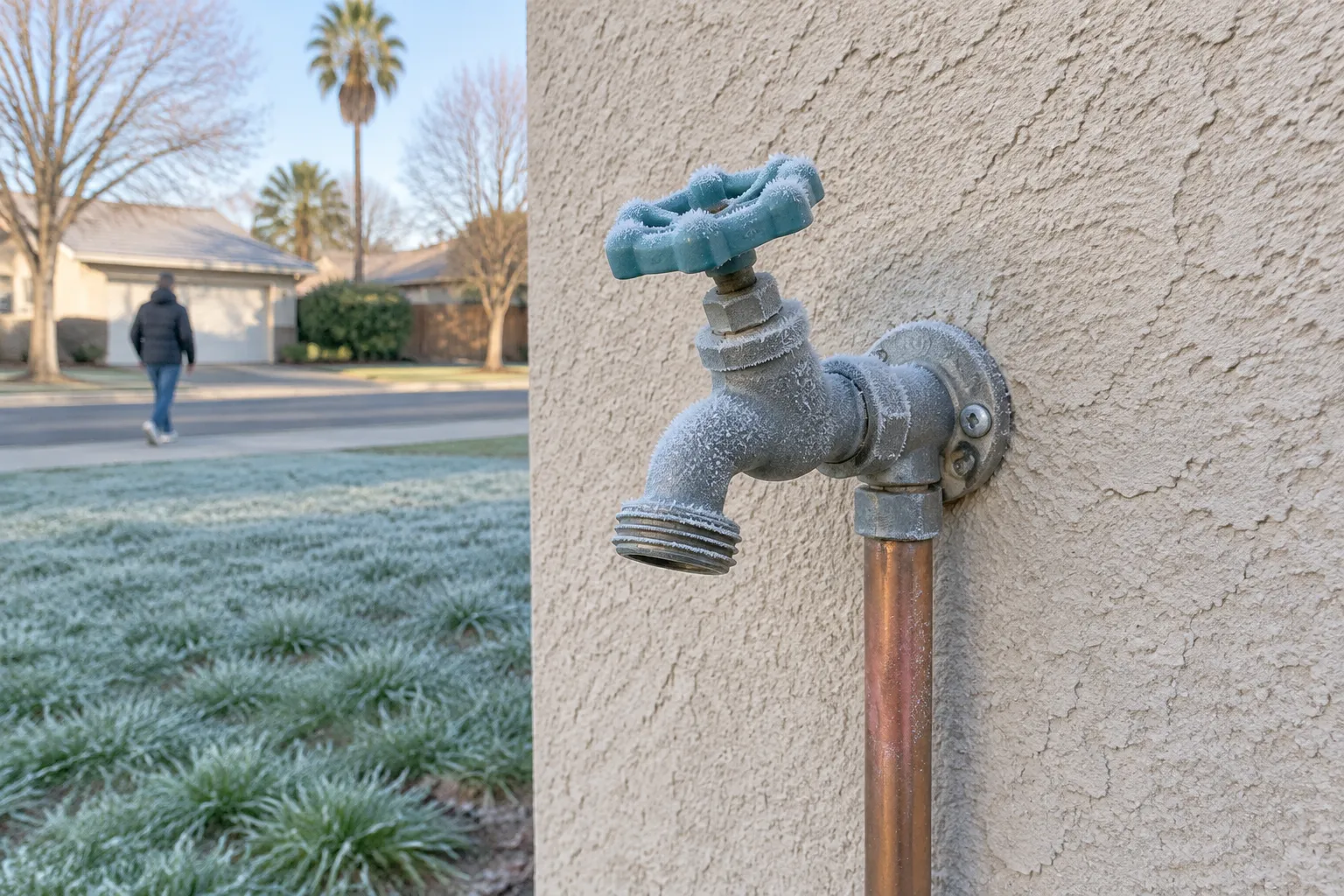
A frozen pipe is a plumbing problem you can often handle for the first ten minutes yourself: find the shutoff, open a tap and warm the pipe gently. Call a plumber when you cannot find the frozen section, it sits inside a wall or crawl space, water is already leaking, or the pipe has split. This page also covers leaks that have nothing to do with the weather, such as a slab leak or a pinhole in copper. For the wider picture, start from the Stockton plumbing home page, or request quotes directly on the quote page.
What should you do first when a pipe freezes?
Keep the faucet on that line open, because running water helps melt the ice and relieves pressure. The American Red Cross suggests warming the pipe with an electric hair dryer, a heating pad wrapped around it, a space heater kept away from anything flammable, or towels soaked in hot water, and keeping the heat on until normal pressure returns. It warns against blowtorches, propane or kerosene heaters, charcoal stoves or any open flame.
Check other faucets too: if one pipe froze, others may have. If you cannot find the frozen section, cannot reach it, or the pipe will not thaw, call a plumber who holds a California contractor license, which is the Red Cross's own advice. If the pipe has already split, shut off the water at the main valve and go to burst pipe repair.
Does Stockton get cold enough to freeze pipes?
Sometimes. Winter lows in the Central Valley hover close to freezing on clear nights, and the 1991 to 2020 NOAA normals put the January average low near 39 degrees Fahrenheit, so a hard freeze is the exception rather than the rule. That is exactly why damage happens: many Stockton homes have little freeze protection, such as exposed hose bibs, pipes in unheated garages, crawl spaces and exterior walls.
The Red Cross suggests letting cold water drip from a tap served by exposed pipes during very cold weather, since moving water is harder to freeze. A plumber can also advise on insulating exposed lines and fitting covers to outdoor spigots, which is cheap compared with a repair.
Who fixes leaking pipes, and what do they do?
A plumber finds the leak, stops the water, and repairs or replaces the damaged section. Finding it can be the hard part when the pipe is inside a wall, under a floor or beneath a concrete slab. Depending on the pipe and the symptoms, plumbers may use listening equipment, pressure tests, moisture and thermal cameras, or a camera inspection.
Typical repair options, from smallest to largest:
- Clamp or repair coupling: a short-term or small-hole fix on an accessible pipe. A full-circle repair clamp wraps the pipe and seals with a gasket. Whether it is acceptable as a lasting repair depends on the pipe and the plumber's judgment.
- Cut out and replace the section: the usual fix for a split or pinhole in copper, PEX or galvanized pipe.
- Reroute around the problem: common for slab leaks, where the plumber runs new pipe through the attic or wall instead of breaking the floor.
- Repipe: replacing most or all of a home's supply lines, considered when leaks keep recurring.
For fittings and pipe types, see SharkBite vs PEX fittings.
Which sealant works on a leaking pipe?
No sealant is a lasting answer for a pressurized supply line. Epoxy putty, wrap tape and similar products can slow a small leak so you can buy time, but they are not repairs, and a pipe under pressure can fail again at the patch. Use them only to limit damage until a plumber arrives, and shut off the water first if you can.
Never rely on sealant for a gas line. Gas piping is regulated work, and a suspected gas leak means you leave the house and call 911 and your gas utility from outside. See gas line repair for how that works.
How do you know there is a leak you cannot see?
Look for symptoms rather than the water: a water bill that rises with no change in use, the sound of running water when everything is off, low pressure in one part of the house, damp or stained drywall, warped flooring, musty smell, or a warm patch on a floor, which can point to a leak in a hot line under the slab. A water meter test, with all fixtures off, is simple: if the meter dial keeps moving, water is going somewhere.
When the leak is under concrete, a plumber confirms the location before anyone cuts or digs. Read about the price drivers on the slab leak repair cost page, and see what a hidden leak at a water heater looks like if the damp spot is near the tank.
How much does it cost to fix a broken pipe in a wall?
Published national cost guides, which are only a guide, show burst pipe repairs at $200 to $1,000 with an average of $500, a burst main water line at $400 to $2,000 and a burst sewer line at $1,500 to $3,000. Water damage cleanup is separate work and is not included. We found no published price for thawing a frozen pipe, so we give no figure. The full range is on the burst pipe repair page.
The plumber quotes the real price after finding the break. Access is the big driver: opening drywall, matching the finish and patching afterward often cost more than the pipe repair itself, so ask whether the quote includes the wall repair or only the plumbing. Insurance rules differ by policy, so read yours. The California Department of Insurance lists sudden and accidental water damage among the usual covered events and seepage or leaks among the usual exclusions, which is why stopping the water quickly and calling your insurer matters.