Plumbing around the Port of Stockton splits into two worlds: a ring of old homes, and a working industrial port. Which one you have decides almost everything about the job. The ZIP code area around the port, 95203, is old housing country, with a median build year of 1955 in the Census Bureau's 2020 to 2024 survey. Port land itself is commercial and industrial, with its own scale of pipework. This page covers what sets the area apart. For the rest of town, see all Stockton areas, or use the form below to get quotes from local plumbing businesses.
What is the area around the Port of Stockton like?
The port is an inland seaport on the Delta of the San Joaquin River, run by a special district that opened on February 2, 1933. The deepwater channel it depends on was first dredged from 1930, is about 35 feet deep, and had major dredging in 1968 and 1982. The former Navy supply depot on Rough and Ready Island, now called the West Complex, passed to the port between 2000 and 2003.
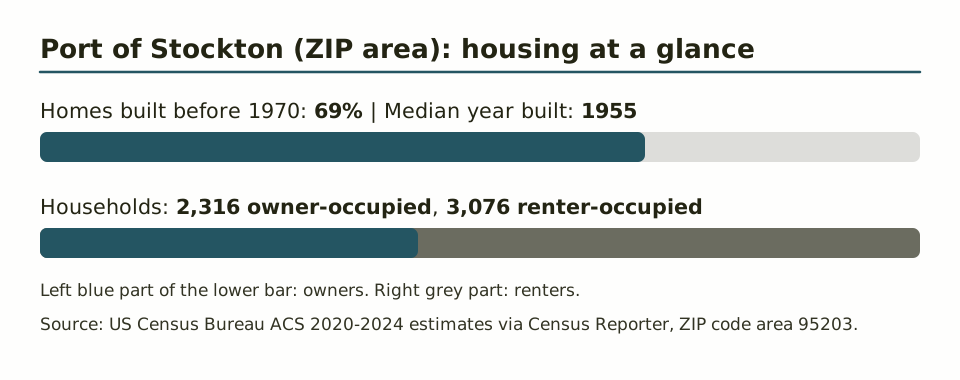
Homes sit around that industrial footprint rather than inside it. The port occupies part of the Boggs Tract neighborhood, a small area east of the port and west of Interstate 5. Because ZIP code 95203 is a postal area and not a neighborhood boundary, treat the housing figures here as a proxy for the ZIP code area around the port, not for any single street.
What do older homes near the port need?
Most homes in the ZIP code area around the port are old. The Census Bureau's 2020 to 2024 estimates give a median build year of 1955, and 69 percent of homes were built before 1970. Of 5,392 occupied households, 2,316 are owner-occupied and 3,076 are renter-occupied, so more households rent than own.
A 1955 house was plumbed long before low-flow fixtures, and pipe from that period can be galvanized steel or cast iron, which corrodes from the inside over decades. Signs that matter: low flow at several taps at once, rusty water after the line has sat unused, or a drain that keeps backing up. The guides on low water pressure and sewer line repair explain what each symptom usually points to.
If you rent, tell your landlord before booking anyone. Who pays depends on your lease and on the repair, and a plumbing business will usually want the owner's approval for anything beyond a basic fix.
How does the water around the port affect plumbing?
Water here is moderately hard to hard, which means scale. Cal Water's 2025 report for its Stockton district describes the water as a mix of local groundwater and surface water bought from Stockton East Water District. It lists total hardness in groundwater from 22 to 290 parts per million, with an average of 150, against 38.9 for the surface supply. Check your water bill to confirm your provider.
Cal Water notes that hard water may lead to mineral buildup in pipes and water heaters. In practice, a tank water heater in a hard-water zone collects sediment faster. Read how to flush a water heater and when an anode rod is worth replacing before the tank gives out.
What affects plumbing quotes around the port?
Quotes depend on the job, the age of the pipe and how easy the plumber's access is, and the port area adds two local factors. Old pipe can turn a simple repair into a larger one once the wall is open. Commercial and industrial sites near the port also fall under different rules than a house: a business with irrigation or process water may need backflow protection, which the backflow testing guide explains.
For commercial rates, see commercial plumber hourly cost. For homes, plumber cost explains what moves a price. A plumbing business gives the real figure after seeing the job, so treat any number you see online as a guide.
Which permits and rules apply near the port?
Within Stockton city limits, building permits go through the City of Stockton's Community Development Department. Parts of Boggs Tract are unincorporated county land, so a job there can fall under San Joaquin County instead. Ask the plumber which office applies to your address.
San Joaquin County's plumbing permit page says a permit is required to install, repair or replace plumbing fixtures, and lists water heaters among them. It exempts stopping leaks, clearing blockages and repairs that do not replace valves, pipes or fixtures. California requires a licensed plumber (CSLB C-36) for most larger plumbing work, and you can check any contractor at the CSLB site, cslb.ca.gov. This site is a quote service. The plumbing business that visits holds its own license.
What about access and timing near the port?
Access is the local factor. Tell the plumber up front if your site is on port land, since access to a working industrial site can need arranging in advance.
Where the leak is active, ask about emergency plumber availability, and shut off the water at the main first. A burst pipe is worth a call at any hour.