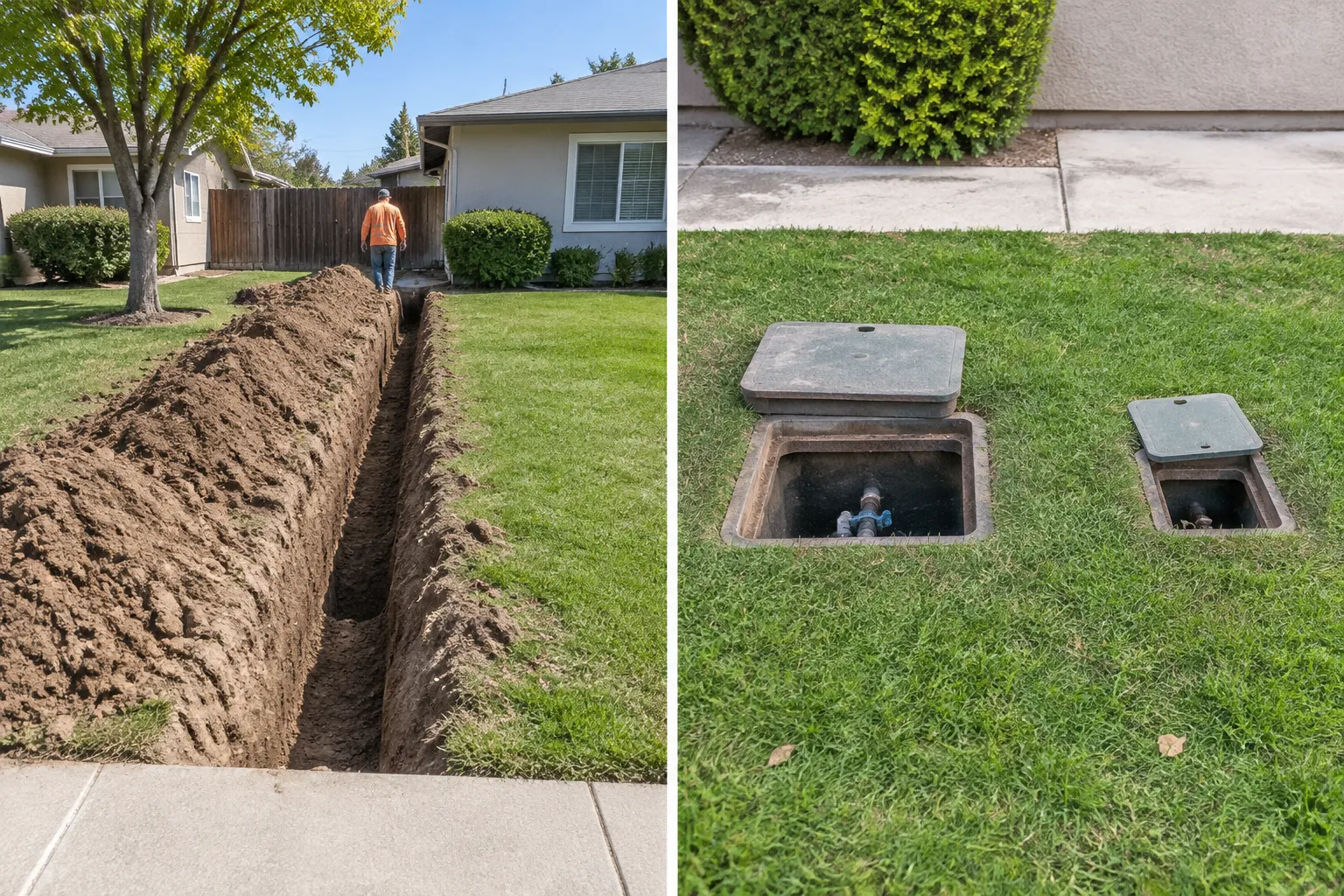
Trenchless repair fixes a sewer line through small access holes, by lining the old pipe or pulling a new one through it. Traditional repair digs a trench along the pipe, removes the damaged section and replaces it. Trenchless usually means less digging and less to restore in the yard, and traditional works on almost any pipe condition. Neither is better in every case: the camera inspection of your line decides. This page sits under sewer line repair plumbers and compares the two so you can read the quotes you get.
What is the difference between trenchless and traditional sewer repair?
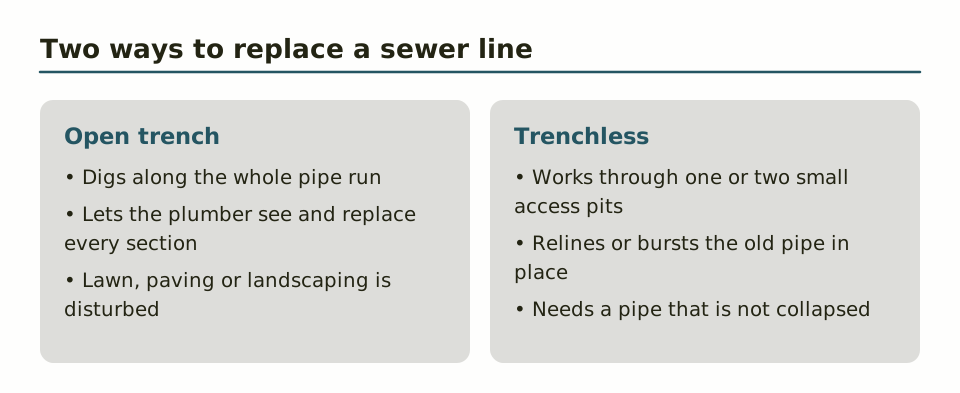
Traditional repair means digging down to the pipe, cutting out the failed section and laying new pipe in the trench. Trenchless repair works from two small access points, either lining the existing pipe with a resin-coated sleeve or pulling a new pipe through the old one while breaking it apart. Both end with a pipe that carries sewage again.
The two main trenchless methods:
- Pipe lining (cured-in-place). A flexible tube coated in resin goes into the old pipe and hardens to form a new pipe inside it. It suits a pipe that is structurally sound enough to hold the liner but has cracks, leaks or root gaps.
- Pipe bursting. A bursting head breaks the old pipe outward while a new plastic pipe, usually high-density polyethylene, is pulled in behind it. It suits pipes that are badly broken or collapsed, and can sometimes allow a larger pipe.
Traditional digging has one clear advantage: the plumber sees the whole pipe, fixes bellies and bad joints directly and can change the slope or route.
When does each method make sense?
Choose by what the camera inspection shows, where the pipe runs and what sits on top of it. Trenchless is often chosen where digging would tear up a driveway, patio, mature tree roots or a landscaped yard. Traditional is often chosen where the pipe is collapsed, bellied or has a bad slope, or where the section is short and easy to reach.
| Situation | Often a fit for |
|---|---|
| Cracks, root intrusion and leaking joints in a pipe that holds its shape | Pipe lining |
| Collapsed, crushed or badly offset pipe | Pipe bursting or digging |
| Pipe that sags and holds water (a belly) | Usually digging, since a liner follows the existing shape |
| Pipe under a driveway, patio or mature trees | Trenchless, if the pipe condition allows |
| A short section near the surface in open ground | Digging may be simple and cheaper |
| Pipe corrosion on old cast iron or clay | Depends on the camera result, as corrosion can weaken the pipe the liner relies on |
An older house may have a main sewer line that is clay, cast iron or an old composite pipe, and these can corrode, crack or let roots in. That is why a sewer camera inspection is the first step for any quote. Ask to see the footage, and see hydro jetting if a line needs cleaning before it can be inspected. See plumber for sewer smell if the signs are odor or backups and you have not yet found the cause.
Is trenchless sewer repair worth it?
It can be, when the pipe condition allows it and when digging would cost you something valuable: a driveway, a patio, trees or time. Trenchless methods usually cost more per job than a simple dig, so the case rests on what you avoid restoring. A short repair in open ground may be cheaper to dig. A long run under hardscape often is not.
Points to weigh:
- Restoration cost. Digging means repairing the trench, landscaping and paving, and that cost often belongs to you, not the plumbing business.
- Disruption. Digging takes more days of work and may close your driveway.
- Pipe condition. Lining needs a pipe that can take the liner. A collapsed pipe cannot be lined.
- Pipe size. Lining makes the inside of the pipe slightly smaller. Bursting can keep the size or increase it.
- Permits. Both methods usually need a permit and inspection, so ask the plumbing business how it works in Stockton and who pulls it.
What problems can come with trenchless repair?
The common ones are choosing a method the pipe cannot support, side connections that are not reopened properly, and a liner or pipe that does not fit well. Some trade sources also note that resin curing can release styrene and other vapors, and that lining reduces the pipe's inner diameter a little. These are reasons to ask questions, not reasons to rule it out.
Ask the plumbing business:
- how the camera inspection led to this method;
- how branch connections and the cleanout will be reconnected and reopened;
- what is done after the work to prove the line flows, such as a second camera pass;
- what the written warranty from the contractor says, and who stands behind the materials;
- what the curing stage involves for your home and how long you will be asked to stay out of the affected rooms or avoid using water.
How long does a trenchless repair last?
Makers and contractors quote decades, often 50 years or more, but no one can promise a figure for your line. The life depends on the old pipe, the materials, the installation and the soil and roots around it. A trenchless repair that is done well on a sound pipe can last a long time, and a poorly done one can fail early.
Be careful with any quote that gives a lifespan as a promise. Ask what the written warranty covers and for how long, and keep the camera footage from before and after the work, because it is your record of the repair.
What affects the price of each method?
The price depends on pipe length, depth, access, method and what has to be restored afterward. Trenchless often costs more per job, and digging adds restoration costs on top of the repair. A plumber quotes the real price after the camera inspection. You will find ranges on sewer line replacement cost.
What moves it:
- Length and depth of the section.
- Access. Whether there are cleanouts at each end or the plumber must create them.
- What is on top. Concrete, a driveway, trees, utilities or a fence.
- Pipe condition and whether a section is collapsed.
- Permits, inspections and any utility locating work.
Before any digging, the plumbing business should have underground utilities located. 811 is the free national before-you-dig service, and homeowners and contractors alike should contact it before they dig. Also check the contractor's license at cslb.ca.gov before signing. Quotes are easiest to compare when each plumbing business works from the same camera footage.