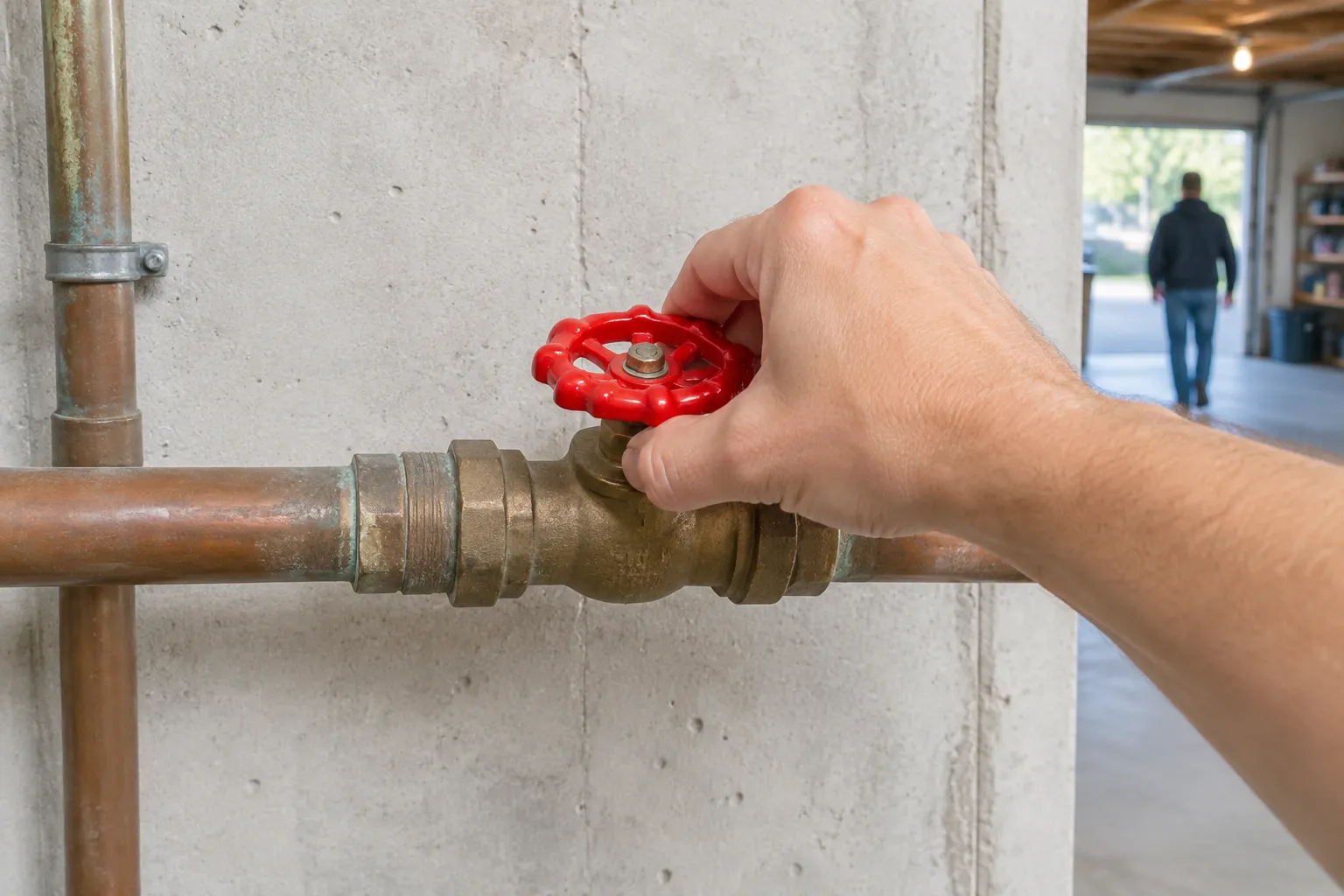
An emergency service plumber is a local plumbing business that takes urgent calls outside normal booking, usually for active water, a sewage backup, or no water at all. If water is running where it should not, shut off the main valve first, then call. If you smell gas, leave the house and call 911 before anyone else. This page covers what counts as an emergency, what to do while you wait, and what to ask on the phone. The wider picture, including how emergency plumbing works across the city, is on emergency plumbing in Stockton.
What counts as a plumbing emergency?
An emergency is water or sewage you cannot stop, a smell of gas, or the loss of something the house cannot go without, such as all water. A slow drip under a sink or a toilet that runs is a repair for a normal booking, and calling an emergency line for it usually costs more.
Treat these as emergencies: a burst or split supply line, water coming through a ceiling, a water heater leaking steadily from the tank body, sewage coming up in a tub, shower or floor drain, and a gas smell. A single clogged toilet with a working second toilet in the home is normally not one. A frozen pipe that has not burst yet is somewhere in between: thaw risk is real, and the guide to a frozen pipe plumber covers it.
If you are not sure, ask yourself two questions. Is damage getting worse by the minute? Is anyone at risk? If both answers are no, you can usually wait for the next available appointment.
What should you do in the first ten minutes?
Stop the source, protect people, then protect the house. For a water leak, close the main shut-off valve. For a leak at one fixture, close the small valve under or behind it. Switch off the water heater if it is the source. Move valuables, and keep clear of any room where water meets electric outlets.
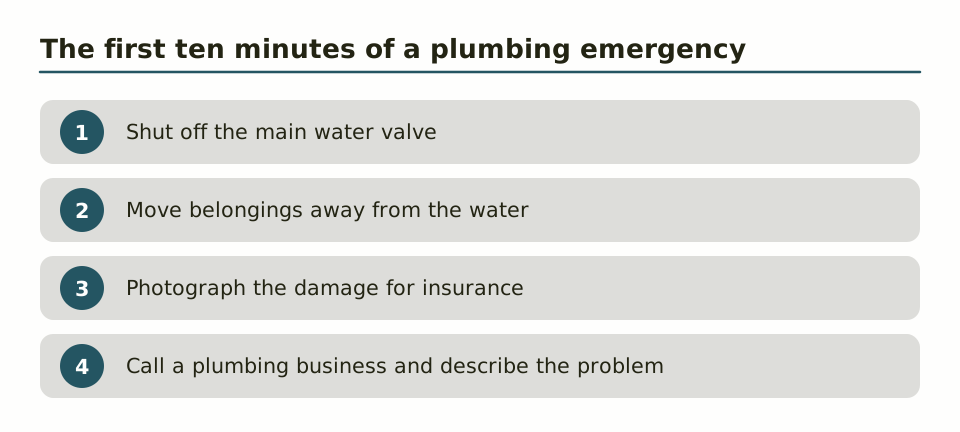
Work through it in this order.
- Find the main shut-off. In many homes it is near the water meter at the street, at the side of the house where the supply enters, or in a garage or utility area. Learn where it is now, before you need it. A round handle turns clockwise until it stops. A lever handle turns a quarter turn, so it sits crosswise to the pipe when closed.
- Open a faucet low in the house to drain the lines once the water is off, which reduces what keeps spilling.
- Turn off the water heater if the leak is at or near it. For an electric heater, switch off its breaker. For gas, set the control to the off or pilot position, or close the gas supply valve to the heater.
- Take photos of the damage before you clean up. They help later with an insurance claim.
- Mop and move, but only where it is safe. If water has reached outlets or the electrical panel, stay away and call an electrician as well.
For a pipe that has split inside a wall, see burst pipe plumber. For a leak with no clear source, plumber for water leak helps you narrow it down.
What do you do if you smell gas?
Leave the building right away and move upwind. Do not use a phone, flashlight, light switch or lighter inside. Once you are a safe distance away, call 911, then call PG&E at 1-800-743-5000. PG&E says to do this and not to rely on smell alone, because other signs include hissing or roaring sounds.
PG&E also explains that you can turn the gas off at the main service shut-off valve near the meter by turning it a quarter turn, so the tang sits crosswise to the pipe. Only do that if it is safe to reach it. Repairs to gas piping are regulated work for a plumbing contractor who holds a California license, which is covered in emergency gas line repair.
What should you ask an emergency service plumber on the phone?
Ask five things: whether they hold a California contractor license, how they charge for an emergency visit, whether the first figure is a fixed price or an estimate, how long until someone can arrive, and what they will do first when they get there. Write down the answers, and do not agree to work you do not understand.
California generally requires a contractor license for work that needs a permit, uses additional workers, or costs $1,000 or more in labor and materials, according to the Contractors State License Board. You can check any business at cslb.ca.gov. A genuine business can give you its license number, and you can compare it with the board's record. This site is a quote service, and the business that visits holds its own license.
Be wary of anyone who will not give a price structure, who asks for the full payment upfront in cash, or who tells you the whole system must be replaced without showing you the fault. A fair emergency visit usually separates the call-out, the labor, and the parts.
Why do emergency visits cost more?
Emergency plumbing costs more because it pulls someone out of a booked day, or out of their evening, weekend or holiday. The extra usually appears as a higher call-out fee or an after-hours labor rate, and the work then adds parts and time. No honest number can be given without seeing the job.
What changes the price: the hour you call, how far the plumber travels, how hard it is to reach the fault, whether parts are on the truck, and whether a permit is needed. Read emergency plumber cost for the breakdown, and 24 hour plumber if you need to understand what round-the-clock availability does and does not mean.
No quote service can promise a same-day arrival. Availability changes by the hour. What you can do is give accurate details when you ask for quotes, so each business can judge the urgency.
What happens after the emergency is stopped?
The plumber makes the leak safe, then tells you whether a full repair can happen now or needs a second visit. A temporary fix such as a capped line or a clamp is common at night. Ask what is temporary, how long it should hold, and what the permanent repair involves, with an itemized quote for that second step.
For a sewer line problem, a camera inspection may come first. For a water heater leak, the tank may need replacing, and emergency water heater repair explains how that decision is made. If water has soaked walls or floors, call your insurer and ask a drying company about moisture, because mold can follow damp materials.