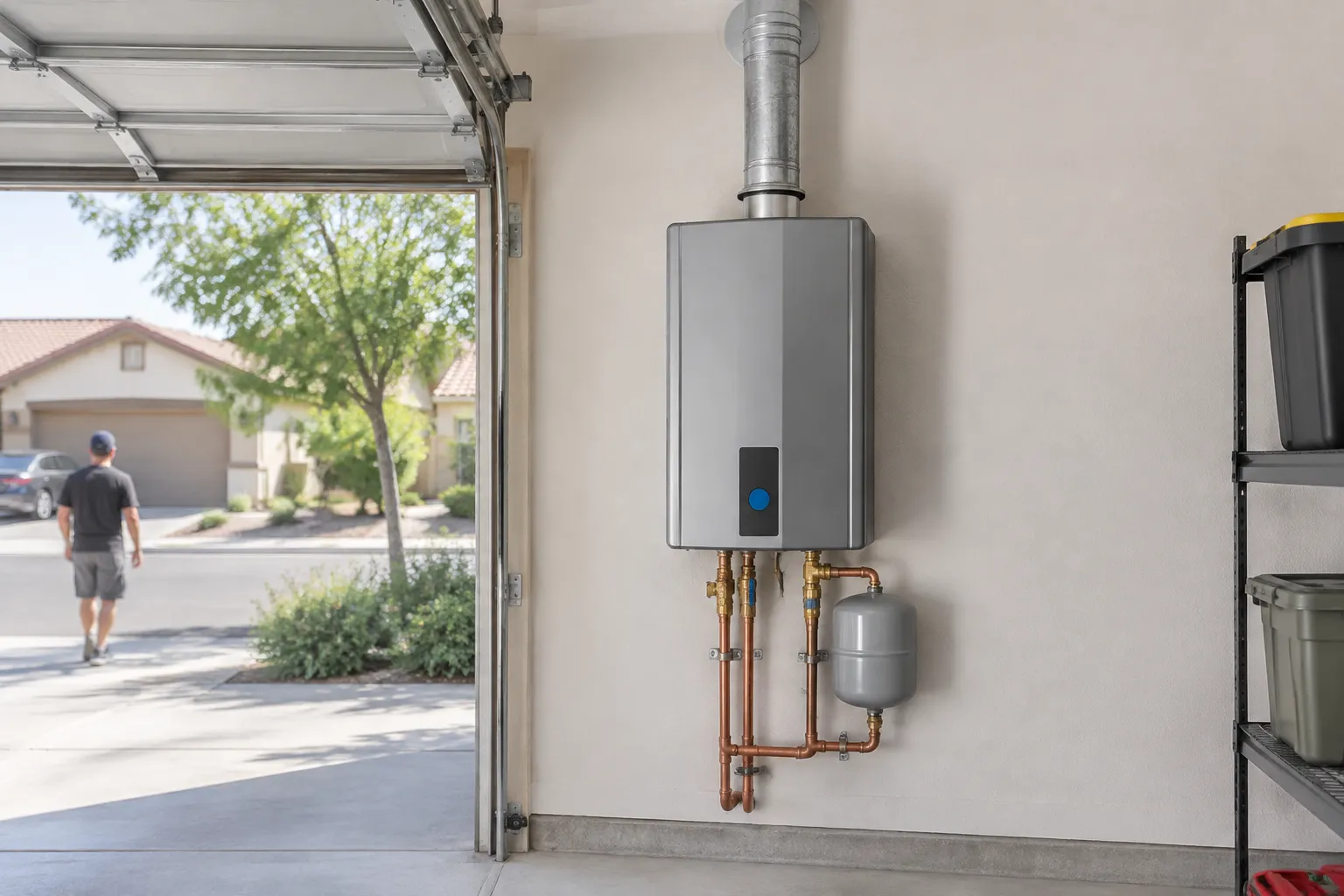
An instant water heater, also called a tankless or on-demand heater, has no storage tank, so it fails differently from a tank heater: usually with no hot water, lukewarm water, or an error code on its display. Many faults come from a power or gas supply problem, a blocked inlet filter or scale on the heat exchanger, and you can check some of those safely. Under California rules, gas and venting work is reserved for contractors who hold a California license. This page sits under tankless water heaters and explains the repair side, so you know what to ask a local plumbing business.
Why is my instant water heater not giving hot water?
The usual reasons are no power or no gas to the unit, a tripped safety lockout, water flow below the minimum the unit needs to switch on, a clogged inlet filter, or scale inside the heat exchanger. The display often shows an error code, and the manufacturer's manual explains what each code means.
Work through the safe checks:
- Look at the display. Write down any code before you reset anything.
- Confirm power: the plug or breaker for electric units, or the electrical supply and display for gas units.
- For a gas unit, check that other gas appliances in the house are working. If you smell gas, leave and call 911, then PG&E.
- Open one hot tap fully. Many units need a minimum flow before the burner or element fires, and a trickle will not trigger them.
- Check whether the cold water supply valve and the hot valve to the unit are fully open.
If a code returns after a reset, or the unit cycles on and off, the next step is usually a plumber with the right tools and the manual. The US Department of Energy says tankless heaters can last more than 20 years, compared with 10 to 15 years for a traditional tank, so repair often makes sense for a unit that is not very old.
Why does my tankless water heater have no water coming out?
If no water at all comes from the hot tap, the cause is more likely a closed valve, a clogged inlet screen, an air lock, or a problem in the pipe than the heater itself. Test the cold tap at the same fixture. If cold water also stops, the supply is the problem, not the unit.
Closed isolation valves are common after a flush or a service visit. A mesh filter on the cold inlet can clog with grit after work on the water main or the street supply. Close the valves, put a bucket under the filter, unscrew it, rinse it and put it back, following the manual. If hot water runs weakly from every tap, scale in the heat exchanger or a failing flow sensor is more likely. A descaling flush uses a small pump and a cleaning solution, and the tankless water heater flush page explains the process.
How do I tell scale from a real fault?
Scale builds up inside the heat exchanger from minerals in the water, and it shows up as falling flow, a rumbling or popping noise, temperature swings, or an error code about temperature or flow. A real fault, such as a failed sensor or igniter, tends to give a code immediately and does not improve after a flush.
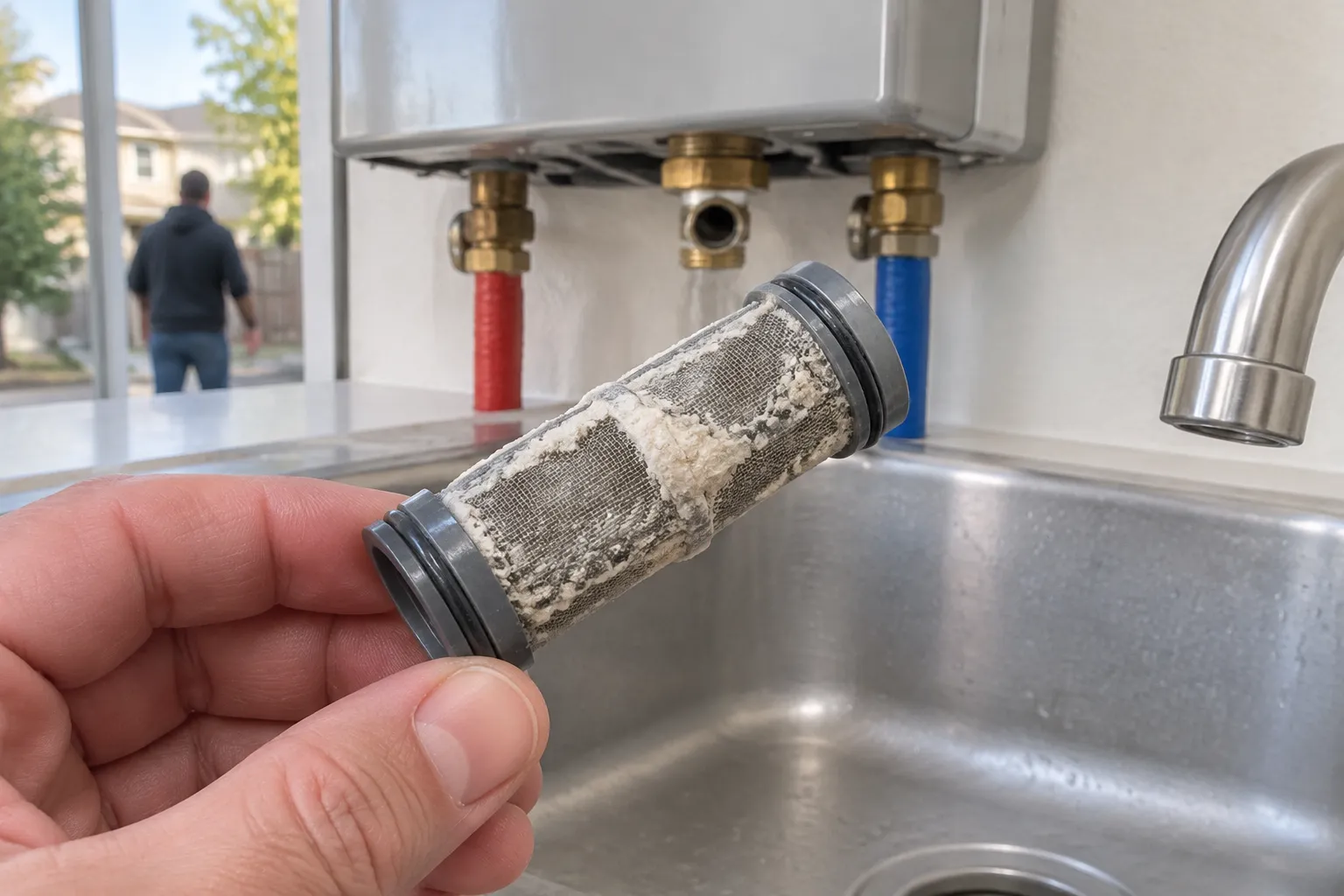
Hard water speeds up scale. The hardness of water in Stockton depends on your supplier and area, so the best source is your water utility's annual water quality report. Ask the plumbing business to test your water and tell you how often a flush makes sense for your unit. Manufacturers state a service interval in their manuals, and following it protects the unit's warranty.
A flush is a maintenance job that some homeowners do themselves with the right kit. Anything that involves opening the gas section, the combustion chamber or the exhaust is for a plumber.
What is involved in installing or replacing a gas tankless heater?
A gas tankless install means more than swapping the box. The gas pipe must be big enough for the unit's higher burner rating, the vent must be the type the manufacturer lists, the unit must be mounted where it meets clearances, and the work usually needs a permit and an inspection. California requires a plumber who holds a California contractor license (CSLB C-36) for permitted work.
Points a plumber will check:
- Gas supply. Tankless units use more gas at once than a tank heater. The existing line may need to be enlarged. Read plumber gas line repair for what that work involves.
- Venting. Most gas tankless heaters use special vent pipe, and the route and length are limited by the manual. Wrong venting is a carbon monoxide risk.
- Condensate drain. Condensing models produce condensate, and the manual says where it can drain.
- Water connections. Isolation valves for flushing, and a pressure relief valve or expansion tank where the manual or the local code asks for one.
Electric units skip the gas and vent, but they draw a lot of power and may need a new circuit or panel upgrade. Follow the manual of the model you buy, whatever the brand. Stiebel Eltron, for example, publishes its own installation manual for each model.
When do a pressure relief valve and expansion tank matter?
A tankless heater has very little stored water, but your plumbing is still a closed system if there is a check valve or pressure regulator at the meter, and heated water expands. Some manuals call for a relief valve on the hot outlet, and some local codes or plumbers add a small expansion tank to absorb pressure.
The rules differ by model and by home, so use the manual and the plumber's judgment rather than a generic diagram. Never cap a relief valve discharge pipe, and do not remove or plug a valve to stop a drip. If you see water coming from a relief valve on or near a tankless unit, shut the unit off and call a plumbing business. A water pressure regulator that is faulty or set too high can also cause relief valve discharge.
Are point-of-use tankless heaters easier to install?
A point-of-use unit is a small electric heater under a sink or near one fixture. It is simpler than a whole-house gas unit because it needs no venting, but it still needs a suitable electrical supply and a correct water connection. Check the amperage on the label against your panel before you buy.
Typical flow from a demand heater is roughly 2 to 5 gallons per minute according to the Department of Energy, with gas units giving higher flows than electric ones. A small point-of-use heater serves one tap, not a shower and a dishwasher at once. If you are weighing it against a tank, see tank versus tankless and the tankless cost page.