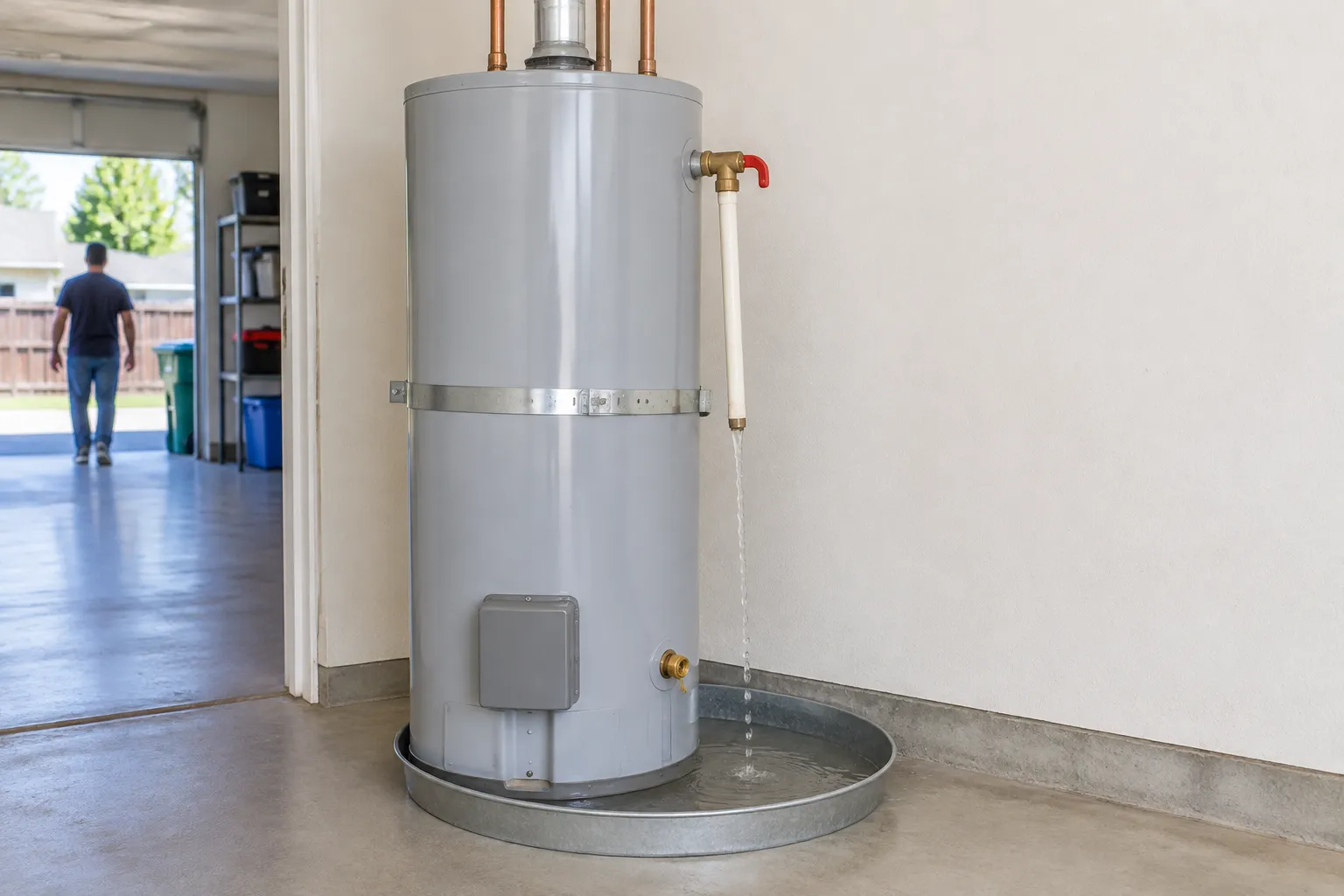
When your water heater leaks, shut off its power or gas and close the cold water valve above it, then look at where the water is coming from. A drip from a pipe fitting or the relief valve can often be repaired. Water seeping from the tank body, or pooling under the heater with no obvious source, usually means the tank has failed and needs replacing. This page sits under water heater repair and replacement and helps you decide which case you have before you call a local plumbing business.
What should I shut off first when my water heater leaks?
Turn off the energy source, then the water. For an electric heater, switch off its breaker. For a gas heater, turn the gas control to off, or close the gas valve on the supply line. Then close the cold water shut-off valve on the pipe entering the top of the heater, and open a hot tap in the house to relieve pressure.
If the leak is large, close the main water valve for the house instead. Keep children and pets away from the area, because water from the tank and relief valve can be hot enough to scald. Do not open the electrical access panel on the side of an electric heater until the breaker is off. If you smell gas, leave the house and call 911, then PG&E, as PG&E advises, and do not attempt any repair.
Put a bucket or shallow pan under the leak, and take a photo of the water and the label on the heater. The label shows the capacity, fuel type and serial number, which a plumber will ask for.
Where is my water heater leaking from, and can it be repaired?
The leak source decides the repair. Water at a pipe connection or a drain valve can often be tightened or replaced. A dripping relief valve points to a valve problem or to pressure in the system. Water that comes from the tank itself, or from the fitting welded to the tank, means the tank has failed and the heater is usually replaced.
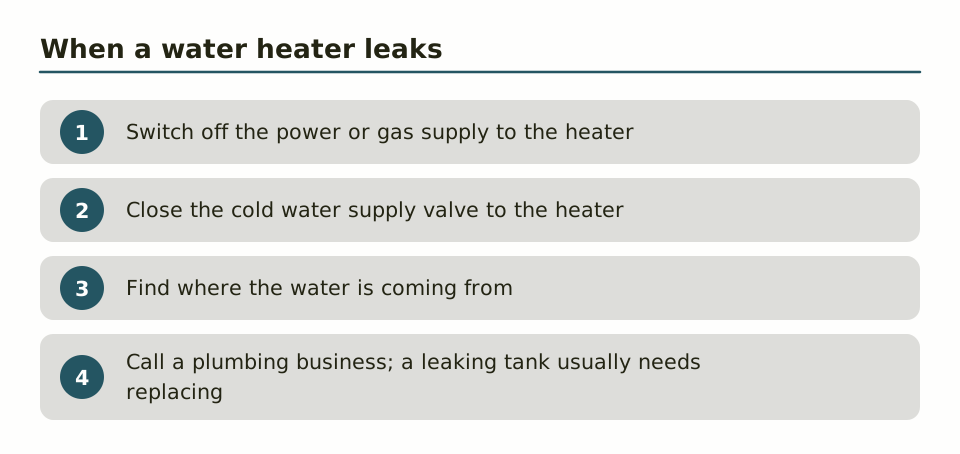
Check these spots in order, with the heater off and cool:
- Supply pipes and fittings on top. Wipe them dry and watch for fresh drops. A loose fitting or failed flexible connector is a small repair.
- Temperature and pressure relief valve. This valve sits on the side or top, with a pipe running down to a drain or outside. Water running from this pipe is covered on the pressure valve leaking page.
- Drain valve near the bottom. A slow drip here can sometimes be fixed by closing it fully or replacing it.
- Under the tank. If the base is wet and you cannot trace the water to anything above, the tank is the likely source.
One manufacturer's service bulletin states that seepage at a fitting welded into the tank cannot be repaired and the heater should be replaced. More background on diagnosis is on the water heater leaking page.
Is a leaking relief valve dangerous?
A relief valve exists to open when temperature or pressure inside the tank gets too high, so a valve that discharges is doing its job, but it should not do so repeatedly. Manufacturer manuals say the discharge pipe must stay open and uncapped, and that a valve which keeps dripping should be replaced by a qualified service technician, using a new valve.
Do not plug the valve or its pipe to stop a drip. That removes the safety protection. A valve that discharges after every heating cycle may point to thermal expansion in a closed system, where an expansion tank or a pressure regulator may be needed, or to a thermostat set too high. The water from the pipe can be scalding. If it is steaming or the tank feels very hot, switch the heater off and call a plumbing business straight away.
When does a leaking water heater need replacing?
A heater needs replacing when the tank itself leaks, because a leaking tank is not something a plumber can patch. It is also a replacement case when it is old, rusty at the base or has repeated problems. The US Department of Energy puts the typical life of a conventional storage heater at 10 to 15 years, so age matters when you weigh repair against replacement.
If you do replace it, ask whether the new heater needs a permit, whether it fits the same space, and what size you need. A common question is a 40 gallon replacement. The right tank size depends on how many people use hot water at the same time, and 40 and 50 gallon tanks are both common choices. The Department of Energy suggests choosing by the "first hour rating", the amount of hot water the heater can supply in an hour from a full tank, and matching it to your busiest hour. The label on the heater lists it. You can compare costs on the water heater cost page, and a new anode rod on an older tank is covered at anode rod replacement.
If you have no hot water at all, the emergency water heater repair page covers what to check first.
Do I need a permit to replace a water heater in California?
In many California cities, replacing a water heater needs a plumbing permit, even like for like, and the plumber normally pulls it. Requirements and fees are set by each city or county, so ask the City of Stockton's building division, or the plumbing business, what applies at your address. This page cannot give a fee, because no single statewide figure exists.
Some things apply across the state. California law requires new and replacement water heaters to be braced, anchored or strapped against earthquake movement, and local permit handouts describe two straps, one in the upper third and one in the lower third of the tank. California also requires a licensed plumber (CSLB C-36) for work that needs a permit. A permit is also a record: it triggers an inspection, which checks the venting of a gas heater, the relief valve discharge pipe and the strapping. Skipping it can cause trouble when you sell the home or make an insurance claim.
The 2025 California energy code leans toward heat pump water heaters, mainly in new homes. If you are replacing one in an existing home, ask the plumbing business which models and requirements apply to your job.
Why is my electric water heater still not heating after new elements and a thermostat?
If an electric heater stays cold after you replaced the elements and the thermostat, the fault is usually elsewhere: a tripped high-limit reset button, a wiring mistake, a bad breaker, a failed second element or thermostat, or a heater that is not getting 240 volts. Switch the breaker off before opening any panel, and stop if you are not sure of the wiring.
Check these in order, with the power off for every physical step:
- Find the red reset button on the upper thermostat and press it firmly. If it trips again straight away, there is a short or a failed part.
- Confirm the tank is full of water before restoring power. Running an element dry destroys it quickly.
- Check that the breaker has not tripped and that both legs of the circuit have power.
- Look for wires connected to the wrong terminals. Upper and lower thermostats connect differently.
- If you have a multimeter and know how to use it, test the elements and the voltage. Otherwise stop here.
Electrical work on a heater circuit can cause shock, and a repair that goes wrong can cause a fire. If steps one to four do not fix it, a local plumbing business can test and sort it out.