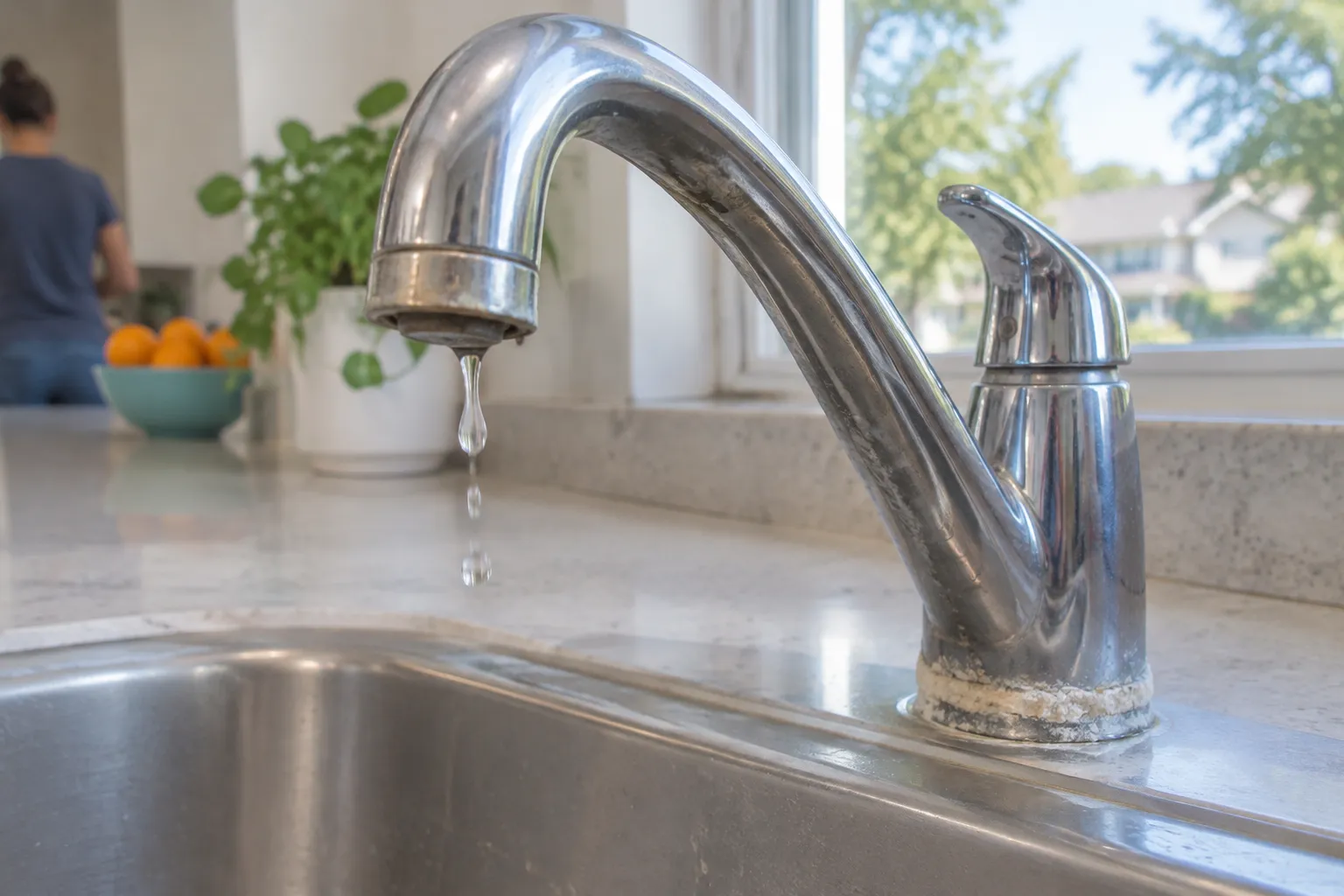
Before you repair a leaking faucet, work out where the water is coming from, because the spot tells you the part. Drips from the spout point to a worn washer, cartridge or valve seat. Water around the handle points to an O-ring or packing. Water pooling at the base points to spout seals, and water under the sink may be the supply line, not the faucet at all. This page sits inside our wider guide to faucets, sinks and showers.
How can I tell where a faucet leak is coming from?
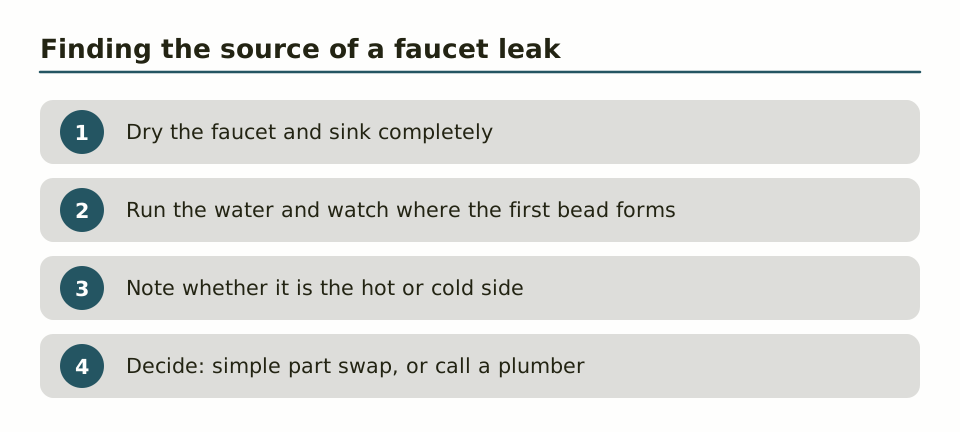
Dry everything with a towel, put a sheet of dry paper towel under the faucet and supply lines, then run the water and watch. The first place the paper darkens is the leak. Check from the spout to the handle, the base, the hoses and shutoff valves under the sink, since a drip at the spout and a wet cabinet floor are two different faults.
Run the faucet with the handle both on and off. A leak that happens only when the faucet is running comes from the handle, base or spout body. A leak that drips when it is off comes from inside the valve. A leak under the sink that happens whether or not the water is running points to a supply line, a shutoff valve or a drain trap, and those are separate parts that you should look at before taking the faucet apart.
What does a drip from the spout mean?
A drip from the spout when the faucet is closed means the part that stops the flow no longer seals: a washer in a compression faucet, a cartridge in a single-handle one, or a damaged valve seat. It is the most common faucet leak and the one the repair guide linked below fixes.
Hard water can speed this up by leaving mineral crust on seats and seals. If you have a cartridge faucet, the replacement cartridge is a matched part, so note the brand and model first. Your step by step guide to fixing a leaking faucet walks through each type of faucet, and a second page explains the repair of a leaky faucet in a short checklist form.
Why is water leaking from the handle or the base?
Water around the handle usually means a worn O-ring or loose packing under it. Water at the base of the spout means the O-rings that seal a swiveling spout have worn out. Both are simple to replace: shut off the water, take the faucet apart, and fit the same size O-rings coated with plumber's grease.
If the leak is at the base of the whole faucet where it meets the sink or counter, check whether water from the sink's rim or a cracked deck is the cause. In a bathroom, a leak from the base of a tub spout can mean the spout's seal, and in a shower, a drip behind the wall can mean a failed valve or a pipe fitting, which a local plumbing business should look at before the wall is damaged.
Why is the water pressure low at my kitchen sink or shower?
Low pressure at one fixture and normal pressure elsewhere points to that fixture: a clogged aerator at a sink, or a clogged showerhead or cartridge in a shower. Low pressure everywhere points to the supply: a partly closed main valve, a failing pressure regulator, or a problem in the water line outside.
Start with the aerator, the small screen at the tip of the spout. Unscrew it by hand or with a cloth over pliers, rinse the screen, soak it in white vinegar if it is crusted with minerals, and screw it back on. For a showerhead, unscrew it, soak it, and clear the nozzles with a soft brush or toothpick. If you have a single-handle shower valve, a worn cartridge or a clogged inlet screen can cut flow. If only hot water is weak at one fixture, check the hot side's stop valve and the connection to the water heater.
If low pressure covers the whole house, the guide on low water pressure goes through the main valve, regulator and the pipes. The main shutoff valve should be fully open, and a gate valve that has been partly closed since a repair is a surprisingly common cause.
How much pressure should a house have?
Many homes run between about 40 and 80 pounds per square inch (psi). California's plumbing code requires a pressure regulator when the water pressure at a property is above 80 psi, as the City of San Diego's utility explains. Very high pressure wears out faucet seals and supply lines, so a faucet that keeps dripping after repair can have a pressure cause.
A gauge that screws onto an outdoor hose bib costs a few dollars at a hardware store and takes the guess out of it. Read it when no water is running. If it is well above 80 psi, a regulator is worth asking a local plumbing business about, and the page on a water pressure regulator covers what it does.
When is a leaking faucet a job for a plumber?
Ask a local plumbing business when the leak is inside the wall, when the shutoff valves under the sink will not close or are themselves leaking, when a part is seized, or when a repair has not stopped the leak. A leak you cannot see, such as a wet cabinet floor with no obvious source, should not wait.
The plumber quotes the real price after seeing the faucet and the pipes. The difference between a spout drip and a wall leak can be a small repair or a bigger job. If the faucet is older or corroded, replacement may be the better choice, and plumbing cost per fixture explains how a quote is built. This site is a quote service: the business that visits holds its own state license, and you can check any contractor at the CSLB website.