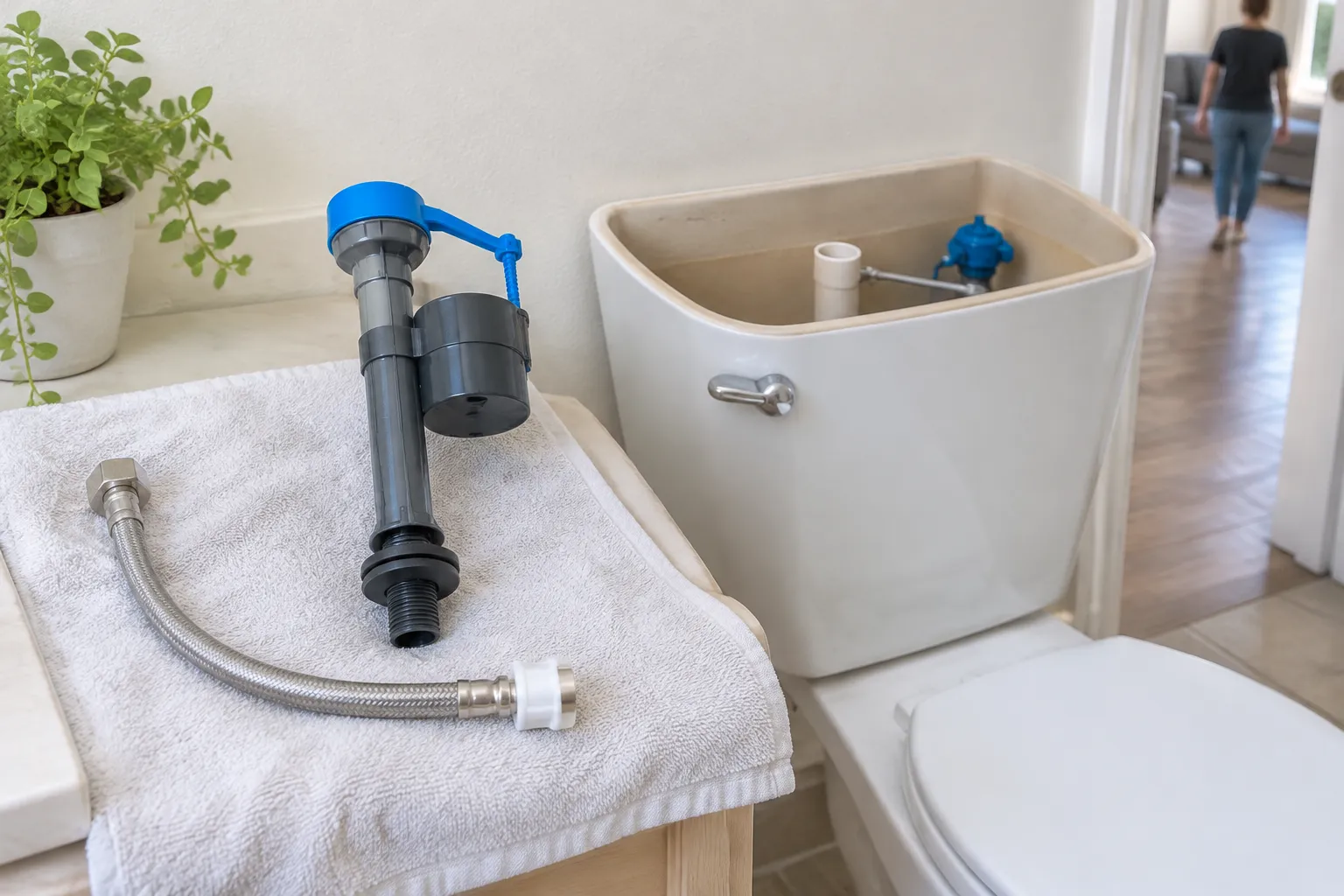
To repair a toilet fill valve, shut off the water at the supply valve behind the toilet, flush to empty the tank, then either adjust the float and clean the valve, or replace the valve with a new one of the same type. Most fill valves are replaced in under an hour with basic hand tools. Before you start, confirm the fill valve is really the problem, because a worn flapper causes similar symptoms. This page walks through the test and the steps. For the wider picture on toilet faults and replacements, see toilet repair and replacement.
How do you know the fill valve is the problem?
Look inside the tank. If water keeps flowing from the fill valve after the tank is full, or it overflows into the overflow tube, or the tank fills very slowly or noisily, the fill valve is the likely cause. If the tank level drops slowly and the valve refills now and then, the flapper is more likely.
Do the dye test to tell the two apart. The US EPA's WaterSense program says to add a few drops of food coloring to the tank, wait 10 minutes without flushing, and see if color shows up in the bowl. If it does, water is leaking past the flapper, not the fill valve. Flush right after so the tank does not stain.
EPA also says a worn flapper can make a toilet flush on its own or silently leak thousands of gallons a year, and recommends replacing flappers at least every five years. If the dye shows up in the bowl, replace the flapper first, since it is the cheaper part. The page on how to repair a running toilet covers that side in detail.
Signs that point to the fill valve:
- Water hissing after the tank is full.
- Water trickling over the top of the overflow tube.
- The tank taking a long time to fill, or filling in bursts.
- A noise like a whistle or a hammering when it fills. If your pipes bang, see water pressure regulator for causes upstream.
What do you need to replace a toilet fill valve?
You need a new fill valve that fits your tank, an adjustable wrench or pliers, a bucket, a sponge or towel, and a small cup. Many universal fill valves fit most tanks, but check the height range on the package and the type of supply connection. A new supply line is often worth fitting at the same time.
Bring the old valve, or a photo of it and the tank, to the hardware store. Tank height matters, because the valve must sit so that the top is above the overflow tube by the amount the package says. Some toilet makers fit their own design of valve. For a Toto toilet, look inside the tank or in the manual for the model name, then match the part to the model, because replacement parts can differ from one brand to another.
How do you replace a toilet fill valve, step by step?
Shut off the water, empty the tank, disconnect the supply line, remove the old valve, fit the new valve, reconnect, adjust the height and the water level, then test. Go slowly, and hand-tighten plastic nuts, because overtightening cracks porcelain and plastic.
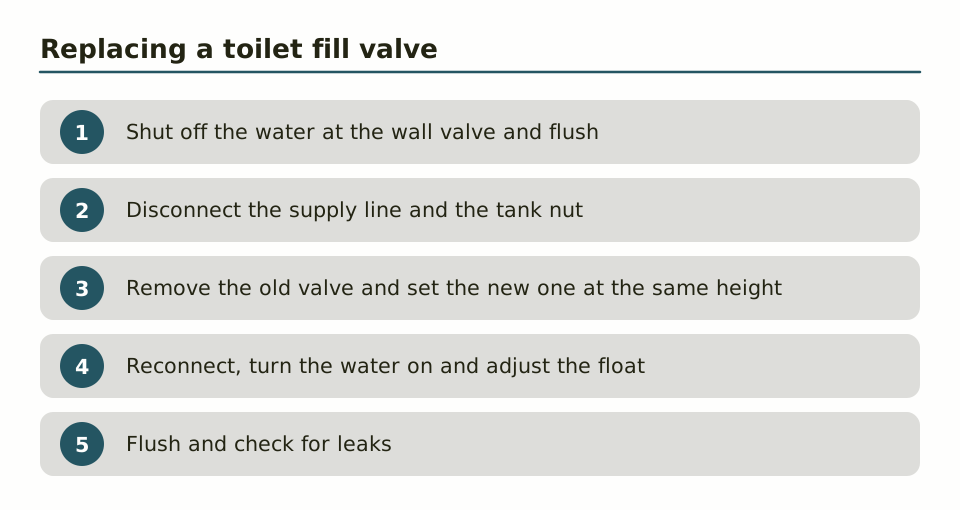
- Close the supply valve behind the toilet by turning it clockwise. If it will not turn or leaks, stop, because that valve may need replacing first.
- Flush to drain the tank, then use the sponge and cup to remove what is left.
- Disconnect the supply line from the bottom of the fill valve, with a bucket under it for the water in the line.
- Remove the old valve. Unscrew the locknut under the tank, then lift the valve out. Some valves unclip from the overflow tube too.
- Set the new valve with its washer in the tank hole, adjust its height to the instructions, and tighten the locknut by hand plus a small turn with pliers if the instructions say so.
- Connect the refill tube from the valve to the overflow tube, with the end clipped above the water line.
- Reconnect the supply line, turn the water on slowly, and look for drips at both ends of the line.
- Adjust the water level to the mark in the tank, or about an inch below the top of the overflow tube if there is no mark, using the screw or clip on the valve.
- Flush a few times and check for leaks around the base of the tank and at the supply connection.
If a leak shows up where the tank meets the bowl or at the floor, that is a different problem, covered in plumber for toilet leak.
How do you fix a running Toto toilet?
Use the same test as for any toilet. Check the flapper with the dye test, then look at the fill valve and the water level. Many Toto models use their own parts, so use the model name from the tank or the manual when you buy a flapper or a valve, and do not assume a universal part will fit.
Start with the simple checks. Make sure the chain on the flapper has a little slack and is not caught. Check the water is not above the overflow tube. If the valve is the cause, lower the float so the valve shuts off earlier, and follow the maker's instructions to clear any debris from the valve. If it still runs, replace the valve.
If you cannot identify the parts, a local plumbing business can read the model and bring the right ones. The fill valve is also called an inlet valve, and repair a toilet inlet valve covers it under that name.
When should you call a plumber business?
Call when the supply valve will not close, when you find a crack in the tank or bowl, when water leaks from the base of the toilet, when a flapper and a new fill valve have not stopped the running, or when you do not want to work with the water line yourself.
A stuck or leaking shut-off valve is a common stopper. Forcing it can break it and flood the room. Turn off the main water to the house before you try to replace one, or let a plumber do it.
Toilet parts are low cost, while water damage to a floor is not, so do not leave a leak for weeks. EPA says household leaks can waste more than 9,300 gallons a year on average. If you rent, tell your landlord first, since many leases assign repairs to them.
If the line that feeds the valve is the part that has failed, burst toilet supply line covers it.